Abelardo de la Espriella Will Face Strong Resistance
The far-right Abelardo de la Espriella won Colombia's presidency in the tightest race in decades. To carry out his extremist agenda, he'll have to go through a Colombian left that, in terms of congressional and people power, has never been stronger.
Abelardo de la Espriella, the far-right candidate, has been elected president of Colombia by the narrowest margin in recent decades. According to the preliminary count, he received 49.66 percent of the vote, compared to 48.70 percent for his rival, the left-wing Iván Cepeda — a difference of barely 250,000 votes.
The victory of the leader of Defensores de la Patria — a movement he created himself for the current electoral cycle — is disastrous news for Colombia, as de la Espriella threatens to roll back the social advances of Gustavo Petro's government (2022–2026) and renew a militarist strategy that could exacerbate the internal armed conflict the country has suffered under for decades.
From a regional standpoint, de la Espriella's arrival to the presidency extends Donald Trump's control over Latin America. The far-right candidate promised submission to Washington and received open support from Trump and other far-right presidents in the region, such as Argentina's Javier Milei and Ecuador's Daniel Noboa. Brazil and Mexico are now the only large countries still governed by the Left in the region, and Brazilian president Luiz Inácio Lula da Silva faces uncertain elections in October.
Colombia has traditionally been a key base for projecting US dominance over its "backyard": it is the country with the largest US military presence (under the pretext of the war on drugs) and, until Petro came to power, was such a faithful ally that it was sometimes called the "Israel of Latin America." In fact, de la Espriella has cited Benjamin Netanyahu as an inspiration.
With the recovery of Colombia, Trump moves closer to realizing his "Donroe Doctrine" as expressed in the 2025 National Security Strategy: a western hemisphere subjected to his geopolitical and business designs.
The outcome of Colombia's presidential election shows the country's extreme political polarization. In the first round, centrist parties together totaled 5 percent of the vote, and conservative candidate Paloma Valencia received less than 7 percent — a much smaller sum than the 24 percent that centrist Sergio Fajardo obtained in the 2022 election. This time the bulk of the electorate rallied around two candidates whose platforms were diametrically opposed. For one segment of society, Cepeda is a dangerous communist and a friend of the guerrilla insurgents. For another, de la Espriella is a fascist and friend of the paramilitaries, and he will end democracy in Colombia, following in the footsteps of El Salvador's Nayib Bukele.
Turnout in both rounds was very high by Colombian standards: 58 percent in the first round on May 31 and nearly 64 percent in the second. Since the mobilized bases of each candidate had already voted, they aimed in the final weeks before the runoff to attract those who had favored centrist candidates. Former Bogotá Mayor Claudia López — known for being a fickle politician who sways whichever way the wind blows — waited until the last days to voice support for Pacto Histórico's Cepeda, limiting the impact of the endorsement, while Third Way centrist Sergio Fajardo didn't endorse anyone.
By contrast, Paloma Valencia, a representative of the Uribista right (heir to former President Álvaro Uribe), immediately threw her support behind de la Espriella — not surprising given the far-right candidate openly draws inspiration from Uribe's militarist strategy against guerrillas and armed groups that caused thousands of civilian deaths in the early 2000s.
Valencia ran in the election backed by Juan Daniel Oviedo, a center-right politician who is openly gay. Given de la Espriella's homophobic rhetoric, there was hope that Oviedo would endorse Cepeda, bringing some of his voters along. But he did not, despite de la Espriella's making homophobic comments specifically directed against him. As in other countries, the radicalization of the traditional right and the triangulation of centrists have been key to the far right's rise to power.
Geographically, the usual political patterns in Colombia were broadly repeated, showing deep territorial divides. Impoverished peripheral regions such as the Pacific coast and the Amazon supported Cepeda by figures that in some cases exceeded 80 percent, while de la Espriella swept Antioquia — the birthplace of Uribismo and paramilitarism — and some areas where violence by armed groups has multiplied in recent years, such as Norte de Santander, on the border with Venezuela. In the big cities, the far right prevailed in Medellín with 64 percent of the vote, while Cepeda won Bogotá.
Ultimately, the Defensores de la Patria candidate managed to appropriate the electorate of the traditional right and mobilize new voters with a demagogic discourse promising a heavy hand and easy solutions to the violence plaguing Colombia. The strategy, though it has already proved ineffective, attracted voters suspicious of Petro's plan for "total peace," which has failed to materialize despite some successes.
For his part, Cepeda gained three million votes since the first round, surpassing de la Espriella's increase of 2.5 million and setting a record for the absolute maximum votes ever obtained by the Colombian left in its history. In the past year, the Pacto Histórico has consolidated itself as the country's principal political force, while Defensores de la Patria remains for now an empty shell, with only three senators and no representatives in the lower house. Yet Pacto Histórico's political power was not enough to win.
The result of the first round, in which de la Espriella beat out Cepeda despite all polls pointing to a comfortable victory for the Pacto Histórico candidate, was a surprise for the Left. Cepeda, a human rights defender with a professorial demeanor and calm tone, ran a traditional campaign consisting of public events in which he explained his platform. In principle, focusing on proposals seemed a good strategy, as Gustavo Petro is ending his term with a relatively high approval rating. It was logical to promise continuity with a government that had achieved good economic results and tangible social gains, such as the reduction of hunger, poverty, and inequality.
This quiet campaign, however, was disrupted by Petro's interventions, often of a histrionic character, and his insistence on maintaining divisive proposals like calling for a constituent assembly — a questionable project, since Colombia's 1991 Constitution is considered progressive, and the main brake on the Pacto Histórico's reform agenda has not been the Constitution but rather the lack of a parliamentary majority and the resistance of political, economic, and media elites.
Only after the scare of the first round did Cepeda distance himself from the president's aggressive tone, aiming to attract the centrist voters who would be key to closing the gap with de la Espriella. Both the candidate and the president dropped Petro's proposal of a constituent assembly. Grassroots initiatives in support of the Pacto Histórico candidate emerged on social media — such as "K-Popers for Cepeda" — and the sober senator even allowed himself to be seen with some influencers. But these were exceptions in a campaign that, on the whole, seemed pulled from the twentieth century.
In contrast, de la Espriella ran an emotional campaign, inspired by those of other far-right populist leaders, with a strong social media presence that exploited the candidate's incendiary rhetoric. Moreover, the millionaire de la Espriella sold the aspirational dream of becoming rich like he is, flaunting his personal wealth in a manner reminiscent of Trump, whom he admires. Between the two rounds, he likewise toned down the most aggressive aspects of his rhetoric, fearing he would alienate moderate voters. But he did not shed the disruptive discourse that allowed him to present himself as the only alternative to the political establishment, even as he received discreet support from the main traditional parties. The desperation of the Colombian population over the increase in violence in recent years and conservative media's favorable treatment of de la Espriella did the rest.
Abelardo de la Espriella plans to "shrink the state" (i.e., cut public spending) by 40 percent, which would roll back the social gains achieved during the Petro administration. In addition, he intends to suspend all negotiations with illegal armed groups — which, to be fair, had faltered — and resume a purely military strategy inspired by Plan Colombia, which was funded by the United States during the presidency of Álvaro Uribe (2002–2010). He also, controversially, plans to restart the spraying of glyphosate, a toxic herbicide, to destroy coca crops.
The most likely outcome will be an increase in rural violence and human rights violations by the military, as already occurred during the Plan Colombia period. Moreover, an escalation of state violence could drive popular support for some armed groups, such as the Ejército de Liberación Nacional (ELN) or Fuerzas Armadas Revolucionarias de Colombia (FARC) dissidents that effectively govern large regions of the country and conceal themselves behind a veneer of political legitimacy. In other words, de la Espriella's strategy could contribute to the power of the armed groups that sow terror among the civilian population.
On the other hand, de la Espriella threatens to expand the extractivist economy behind environmental degradation and the impoverishment of peasant, indigenous, and Afro communities in large areas of Colombia. This poverty, in turn, feeds the country's persistent violent conflict, since the lack of alternatives pushes many peasants to join armed groups. The new president will certainly bury Petro's ambitious green agenda that included banning new fossil fuel exploration.
The good news amid the disaster that Abelardo de la Espriella's arrival to the presidency represents is that he will encounter strong resistance in implementing his agenda, forced to weave alliances in Congress with the political establishment parties he campaigned against. Although these parties (mostly conservative) are likely to give him more leeway than they granted Petro, the push and pull with professional politicians will be a source of contradictions for a president who made anti-party demagoguery a cornerstone of his electoral victory.
At the same time, the Left is arguably stronger than ever in Colombia. Since the Pacto Histórico, the broad coalition that brought Petro to power in 2022, became a party, it has become the largest in Congress, and it remains the most organized political force in the country. Iván Cepeda has confirmed that he will lead the opposition, where he will have the task of keeping the Left united and making it difficult for de la Espriella to implement his agenda while preparing for a possible candidacy in 2030.
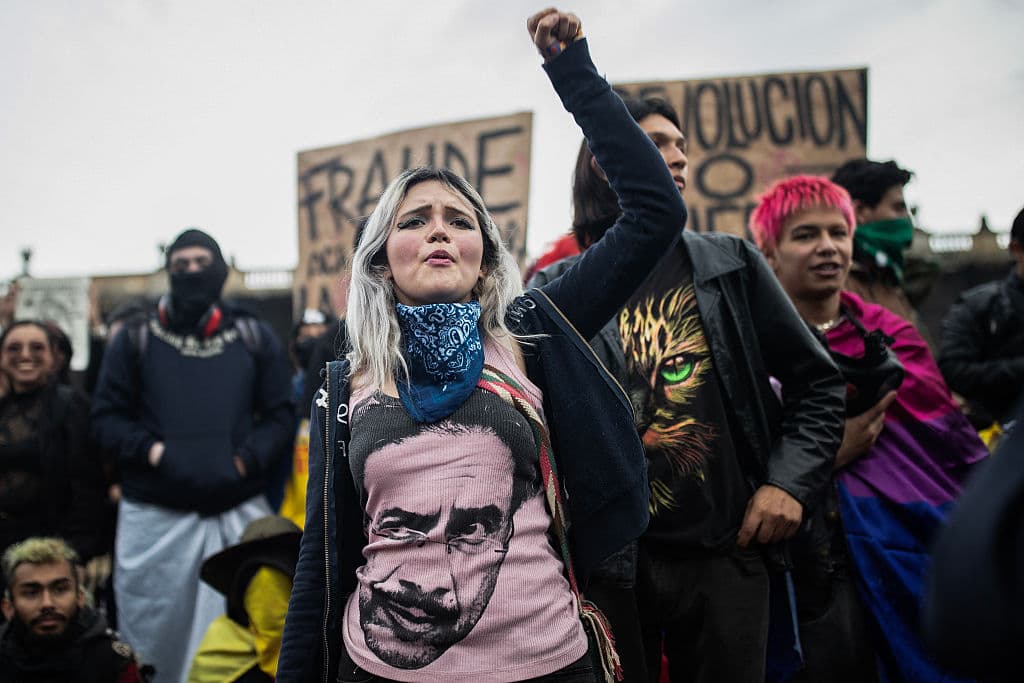
Resistance is also expected in the streets. The 2021 National Strike, which brought millions to the street to protest, succeeded in stopping the regressive tax reform sought by then-resident Iván Duque and laid the groundwork for the Pacto's victory in 2022.
If the president-elect tries to implement his extreme agenda of social cuts, militarization, and unrestrained extractivism despite his limited electoral and social legitimacy, a strong resistance could derail at least some of his plans.