As 2027 French presidential election looms, there's only one certainty: The extreme right
In an unstable political climate where citizens are disillusioned by political leadership, parties are struggling to present a candidate to challenge the popular RN.
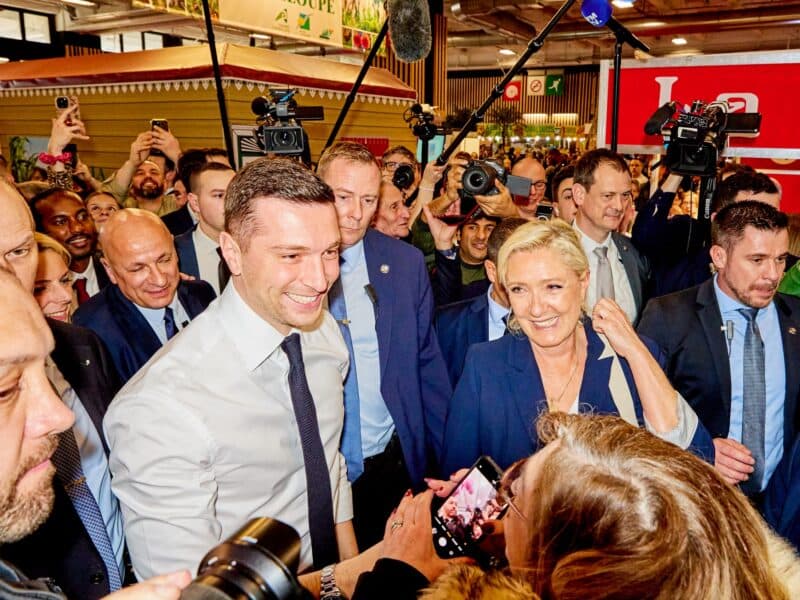
PARIS (CN) — The rising success of France's extreme-right National Rally is triggering a scramble ahead of the 2027 presidential elections: The other parties are working on the assumption that there's only one spot left in the two-candidate runoff.
"The election campaign has started, but it's starting in a bit of confusion because there are so many candidates … because the political parties are relatively weak," Luc Rouban, senior research fellow at Sciences Po Paris, said. "In the second round, there will inevitably be someone from the National Rally."
It's still uncertain who this someone from the party known as the RN will be. In March 2025, leader Marine Le Pen was convicted of embezzling millions in EU funds. Part of her sentence was a five-year ban on running for public office. She appealed; a final decision on her eligibility is due July 7.
But there is a backup plan. If she can't run, her 30-year-old protégée Jordan Bardella will. He has widely been credited with normalizing the RN, long seen as taboo in France because of its roots in overt antisemitism, propagated by the party's late founder Jean-Marie Le Pen — Marine Le Pen's father.
It's not unusual for the RN to make it to the final campaign stretch. In President Emmanuel Macron's previous two successful runs, he faced off against Le Pen. In France, voting occurs in two rounds; if one candidate doesn't get more than 50% of the vote in the first round, the two candidates with the most votes go to a runoff.
However, this election is coming at a time when the RN has more public support and political strength than ever before. And so far, fewer candidates are creating the same momentum.
When asked to parse the current state of France's political climate, experts selected a bleak array of words: Fragmented, anxiety-inducing, uncertain and disintegrated, to name a few. There are cracks across the board.
The left is divided between the extreme-left France Unbowed leader Jean-Luc Mélenchon, who has announced his candidacy, and the more moderate Greens and Socialists, who have yet to choose contenders.
Mélenchon is a controversial figure who advocates for the end of capitalism and ultimately revolution. Although he presents himself as a former Trotskyist, in Rouban's view he's more of a Stalinist, ruling France Unbowed with an iron fist.
"He represents what I would call an insurrectionary, revolutionary left," Rouban said. "He is very brilliant, he is highly cultured, he is a very skilled speaker — a great orator — but he is frightening, and this is clearly seen in the polls … France Unbowed is the party that causes fear, one that is viewed … as a party that is dangerous to democracy."
During France's 2022 presidential election, Mélenchon won 21.95% of the vote in the first round, just behind Le Pen's 23.15%. However, since then his party has become problematic. After Hamas attacked Israel in October 2023, his rhetoric has been widely conceived as antisemitic and radical.
"There is something new about Mélenchon — the way he openly embraces the fact that he is dividing the country," Jean-Yves Camus, a political scientist, researcher and author specializing in far-right movements across Europe, said. "But he's succeeding at something significant; leading a party whose approval rating is lower than the RN, which means there are more French people who consider France Unbowed a threat to democracy than there are those who consider the RN a threat to democracy — that is truly something absolutely incredible."
In the center, a distrust of Macron has generated skepticism toward his former Prime Minister Gabriel Attal, a potential candidate.
"The fact that he is the heir to Macronism is still a problem for him, because deep down, people are very critical of Emmanuel Macron," Rouban said. "So the 'neither right nor left' solution doesn't interest many people anymore today."
However, polls show the moderate right-wing former prime minister, Edouard Philippe, could have the best shot. Olivier Costa, a political scientist and director at the Center for Political Research at Sciences Po, thinks Philippe fits the profile: He has the right political experience and charisma to be president.
But Camus believes his prior links to Macron could also be a roadblock.
"If the polls are to be believed, there is a sense that the second round will pit Edouard Philippe, who is politically aligned with Emmanuel Macron, against the RN candidate … But at the same time, every opinion poll and survey shows that the favorite word among the French right now is 'change,'" Camus said. "Change, which could mean that everyone who held office during Emmanuel Macron's two terms, or who is running for the presidency for the third or fourth time, will actually be rejected by the French people."
Although a few names of right-wing politicians are being floated — including former Interior Minister Bruno Retailleau — it's unclear if any could rally the support needed to challenge the RN.
There will likely be at least 10 candidates; however, these choices come as the general public is largely disillusioned by the political system.
"There is a great appetite for democracy, and at the same time, a great distrust of politicians," Ludovic Renard, a political science professor at Sciences Po Bordeaux, explained. "To me, the criteria aren't very clear regarding what is expected of a political figure."
In Costa's view, the landscape has disintegrated into a crisis; there is widespread distrust in political parties, leaders and institutions, and the extremes of the spectrum are taking advantage of this.
"The context of these elections is one of immense uncertainty regarding the forces at play and the candidates," he said. "Since the system is truly being disrupted, I would say that a great many candidates believe this could be their chance to get elected, which adds even more to the confusion."