Burnham vows seismic shift of power away from London if elected UK leader
The Labour leadership frontrunner said Britain's highly centralized state has held back growth and promised to move power, investment and decisionmaking to local communities.
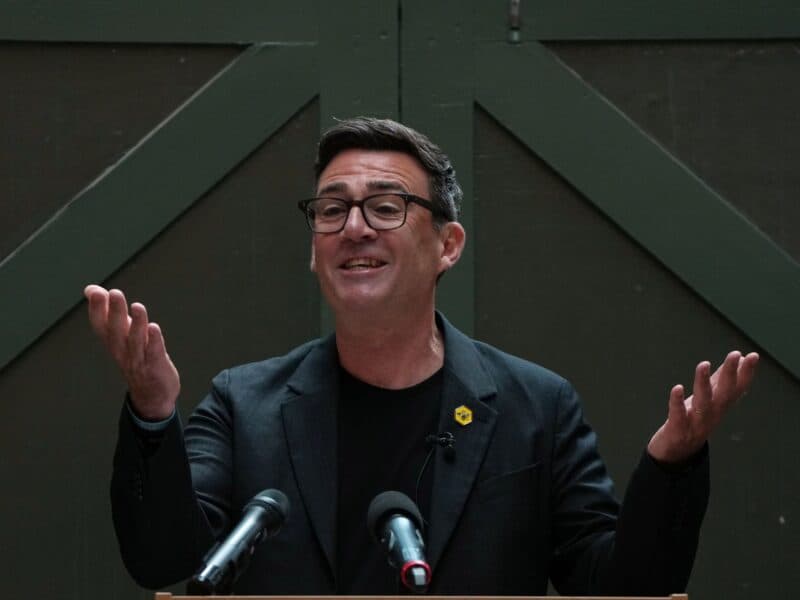
MANCHESTER, England (CN) — Andy Burnham pledged Monday to carry out the biggest transfer of power away from Britain's central government in decades if he becomes prime minister, arguing the country's highly centralized political system has held back economic growth and left local communities unable to solve their own problems.
Speaking at Manchester's People's History Museum, Burnham used his first major policy address since launching his campaign to succeed Prime Minister Keir Starmer to outline a 10-year plan to devolve powers over housing, transport, utilities, employment and economic development to Britain's regions and cities.
The speech comes one week after Starmer announced he would resign after losing the confidence of Labour lawmakers, triggering a leadership contest that Burnham now leads. Former Health Secretary Wes Streeting has since backed Burnham rather than challenge him, leaving the former Greater Manchester mayor on course to become Britain's next prime minister around July 20 if no other candidate enters the race before nominations close on July 9.
Burnham said Westminster's political culture had become too centralized to tackle Britain's stagnant economy and falling living standards.
"After 10 years of political turbulence since Brexit and 20 years of falling living standards since the 2008 financial crash, Westminster hasn't been working for people," he said.
"In fact, it is broken," he added. "And, as a result, the country isn't where it should be. It is stuck in a rut."
He promised to create a "No. 10 North" operation based in Manchester that would coordinate a nationwide effort to devolve powers from Whitehall, the collection of government departments that directs most domestic policy from Central London. No. 10 Downing Street is the prime minister's residence and office.
Rather than concentrating authority in the capital, Burnham said local leaders would receive greater control over transport, housing, employment and industrial policy "by taking power out of the center," while regional governments would help lead a national strategy to raise living standards over the next decade.
He also proposed Britain's largest council house building program since the years after World War II, favoring British companies in public procurement, greater public control over essential utilities and an expansion of technical education alongside universities.
Burnham argued the "Manchester way" of collaboration between local government, businesses, universities, community groups and trade unions could become a national model for economic growth.
The proposals represent the clearest policy blueprint yet from the man widely expected to replace Starmer and would amount to one of the biggest constitutional changes in modern British government if enacted.
During his nine years as mayor, the city region brought buses back under public control, introduced capped fares, expanded the network to include trams and cycling infrastructure and secured greater local control over healthcare and social care spending.
Supporters say those policies demonstrate what local leaders can achieve with greater powers, although critics argue many of the region's biggest challenges, including housing shortages, remain.
Britain's centralized system developed over decades but accelerated during the 1980s under Prime Minister Margaret Thatcher, whose Conservative government abolished councils, limited local taxation and shifted greater financial control to Whitehall.
Later governments created devolved governments in Scotland, Wales and Northern Ireland and introduced elected metro mayors across parts of England, but most taxation and spending decisions remain controlled by the central government.
According to research by the Centre for Cities, about 95% of tax revenue in the U.K. is collected or controlled by the central government, leaving local councils and metro mayors with just 5% of revenues.
That makes Britain the most fiscally centralized country in the Group of Seven major industrialized economies — roughly twice as centralized as Italy, the next closest country.
The think tank argues the concentration of financial power in Whitehall has constrained Britain's economic performance.
Research by the Organisation for Economic Co-operation and Development also shows British local governments play a much smaller role in public investment than their counterparts in comparable developed economies.
Local authorities account for 29.3% of public investment, compared with an OECD average of 54.6%, while direct local government investment amounts to just 0.9% of gross domestic product, about half the OECD average.
Burnham argued this system prevents local leaders from responding quickly to the needs of their communities.
"The country spends too much time arguing and not enough time doing," he said. "Growth cannot be ordered from the top down. It can only be nurtured from the bottom up."
Kemi Badenoch, leader of the right-wing Conservative Party — the largest opposition party in Parliament — challenged Burnham to present his plans to lawmakers, arguing he was "prime minister in all but name."
Addressing Burnham during a speech Monday morning, Badenoch said Britain faced a "summer of chaos" and warned public spending was "spiraling out of control."
She dismissed Burnham's proposals as "old hat" rather than the radical reset he had promised.
Ed Davey, leader of the centrist Liberal Democrats, welcomed Burnham's focus on change but questioned whether another Labour leader would deliver different results.
"Andy Burnham has a very short window to turn this government around," Davey said. "The country is impatient for change. People have heard fine words before only to be let down badly because nothing really changes. We can't afford more of the same."
Whether Burnham gets the opportunity to implement those plans will become clear within weeks.
If no challenger enters the Labour leadership race before nominations close on July 9, he is expected to be elected unopposed and become Britain's next prime minister in three weeks.
Courthouse News reporter James Francis Whitehead is based in England.