Denmark's Frederiksen opens third term with women-led coalition
A boost in free healthcare and tax reduction dominate ambitious goals set by the fresh Danish center-left government, led by a prime minister with one eye focused on Greenland and Donald Trump.
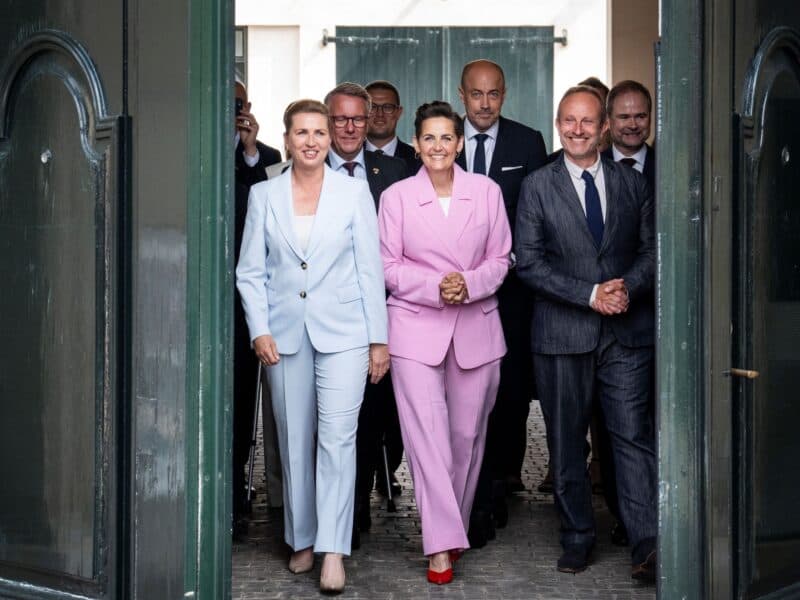
(CN) — The public could count 21 smiles Wednesday as Denmark's Prime Minister Mette Frederiksen presented her new center-left, majority-women team to start her third term, after a ceremonial meeting with the king in the capital of Copenhagen.
The coalition — consisting of Frederiksen's Social Democratic Party, the Green Left Party, the centrist Moderates and the Social Liberal Party — aims to provide free dental care for all Danes by 2030, eliminate sales tax on fruits and vegetables and lower it on other food, and offer youth under 22 free public transportation.
"I am proud of the government foundation that we have created together. And I am proud that in a time of unrest and increased tensions, we can lay an optimistic foundation for you Danes," Frederiksen told a crowd at the royal palace.
Critics say the government hasn't provided details on financing its programs, leaving an opening for the right to attack.
Jakob Chang, a Copenhagen resident and social worker, wondered about funding such projects.
"Free dental care sounds fantastic, and it's something that people have highly sought after. With other healthcare being free, it's always been a question why dental care was not. It's a nice promise, but where will the money come from?" he said in a phone call with Courthouse News.
On Tuesday, four representatives from each coalition party said while details were not settled, they were confident funds would be found.
Change said he believed some of the plans will be accomplished.
"There will always be promises breached, so I don't believe that all of the policies will become reality. However, something like free dental care, I think, will happen. And it's great that they will prioritize providing it to those in need first, before we all can eventually draw benefit," he said.
While boosting welfare, the center-left government also plans to lower the corporate tax and do away with the top income tax bracket. The eco-socialist Red-Green Alliance, which backs the government, will oppose the changes if they increase inequality, chairman Pelle Dragsted said in a news briefing Tuesday.
The left-wing party is also against concerned about immigration policies that could clash with human rights conventions.
"We are firmly opposed to the deportation reform, and in general to a large part of the government's immigration policy. We will be a strong opposition, and that is probably needed," said Dragsted.
Frederiksen has become the EU poster child, together with Italian Prime Minister Giorgia Meloni, for a push to reframe the European Convention on Human Rights, giving member states more national judicial leverage to deport immigrants who commit crimes.
To realize some of the immigration policies, the new government will have to find a majority without the Red-Green Alliance, leaving it to negotiate with opposition parties.
With the fresh coalition, Frederiksen enters the hall of fame for Danish prime ministers who have served the Nordic country for three terms. The result wasn't guaranteed after poor election results for her Social Democrats. Frederiksen herself earned nearly a third fewer votes than in 2022 — about 42,000, or around 20,000 less than her previous election.
Moderate leader Lars Løkke Rasmussen will retain his key position as minister of foreign affairs. The experienced politician at first worked to replicate a similar version of the publicly unpopular previous cross-party government coalition.
Rasmussen's reluctance to choose either the left or right resulted in the longest government negotiation ever in Danish history, around 70 days, after a deadlock election that scattered voters across the political spectrum.
The duo of Frederiksen and Rasmussen, who have worked together to counter U.S. President Donald Trump's Greenland takeover plan over the past year, remains intact. Greenland is an autonomous territory in the Kingdom of Denmark.
Last week Trump posted a picture of himself peering over mountains behind what looks like a Greenlandic village, accompanied by a large caption saying "Hello, Greenland!"
After meetings earlier this year with NATO Secretary General Mark Rutte, Trump cooled down threats to take the Arctic island by force. He has emphasized the importance of "having" Greenland for U.S. national security. Greenlandic and Danish governments are open to increasing American military presence on the territory but have drawn a line at a U.S. takeover.
In a policy document released Tuesday, the government reiterated its position that Greenland must have a right to self-determination; while staying within the Danish Kingdom, the government seeks to remain steadfast to its territorial sovereignty.
Washington and Copenhagen are negotiating about Greenland via a closed diplomatic group.
Officials wrote in the paper that Denmark will continue to strengthen ties with European allies, while the U.S. is creating uncertainty with its NATO stance, forcing the world into a "difficult" security situation.
The new coalition also set surprising eyes on foreign technology, a subject that did not dominate the election.
Danes lead Scandinavian countries in artificial intelligence use, with around 80% of 18,000 people surveyed saying they have already used the technology, consulting firm EY reported in April.
The new government will push for a "strategic and balanced approach to artificial intelligence" in both the public and private sectors, as civilian "manipulation" by tech giants' algorithms challenges Danish democracy, officials wrote.