European judges fault Ukraine over ouster of constitutional court chief
Ukraine violated the rights of a former constitutional court president after the judges who pursued the case against him also helped decide it, rights court judges found.
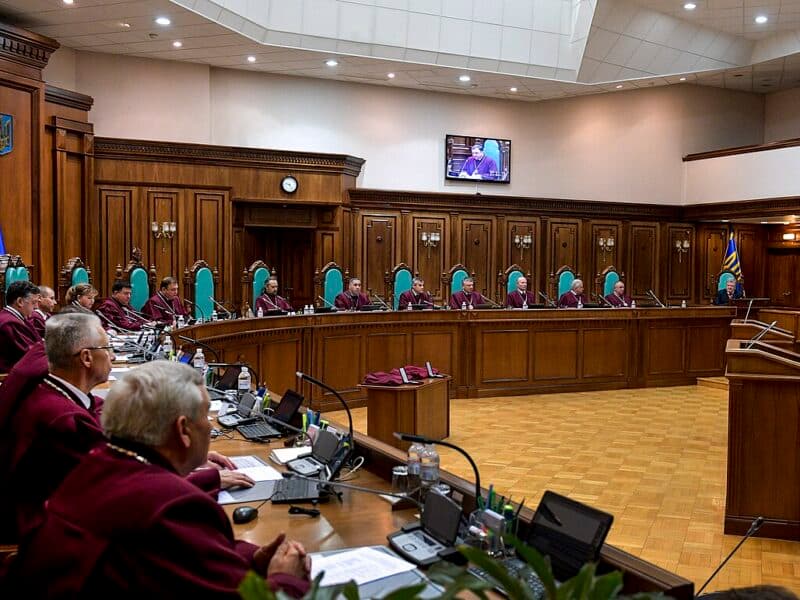
An internal revolt that toppled the head of Ukraine's constitutional court has now landed the country with a European human rights violation.
The European Court of Human Rights ruled Thursday that Ukraine violated the rights of Stanislav Shevchuk, a former president and judge of the Constitutional Court of Ukraine, when fellow judges removed him from the bench in 2019. Shevchuk argued the disciplinary process was unfair, legally unpredictable and unlawfully damaged his career and reputation.
The Strasbourg judges did not weigh whether Shevchuk's conduct warranted discipline. They instead found the process itself fell short of basic fairness.
Two judges who made the key accusations against Shevchuk later sat on the ethics commission reviewing those accusations, voted for his dismissal and then joined the final vote removing him.
"It has not been shown that no panel could have been formed to deal with the case without Judges Sa. and Sl.," the rights court wrote.
The judges also found that Ukrainian law failed to clearly define when conduct justified firing a constitutional court judge. Although the claims centered on Shevchuk's actions as court president, including appointing unpaid advisers, speaking publicly during a presidential election and interfering with the court's internal administration, he ultimately lost his judicial office.
"The Constitutional Court did not explain its decision to use disciplinary proceedings intended to deal with disciplinary offenses of judges to address what it considered to be irregularities in the applicant's administrative work as the president of the Constitutional Court," the judges said. "The court concludes that the interpretation of the relevant domestic rules in the applicant's case did not meet the Convention requirements of clarity and foreseeability."
Shevchuk, who was elected to Ukraine's Constitutional Court by Parliament in 2014 and became its president four years later, was ousted during one of the country's most politically charged periods for judicial reform. Just weeks earlier, the court had struck down Ukraine's illicit enrichment law, a cornerstone of the country's anti-corruption framework, triggering fierce criticism from reform groups and Western partners.
The court also leaned on guidance from the Venice Commission, the Council of Europe's constitutional law advisory body, which told the judges that constitutional courts should generally discipline their own members but must provide strong safeguards for fairness and impartiality.
Andrii Nekoliak, a re:constitution Fellow and Marie Skłodowska-Curie Postdoctoral Fellow at the University of Tartu, said the ruling is likely to influence the next round of judicial reforms in Ukraine, particularly the rules governing disciplinary proceedings against constitutional judges.
"The judgment is primarily about institutional safeguards rather than the merits of Stanislav Shevchuk's conduct," Nekoliak said. He said the court's reliance on the Venice Commission's advice also underscores how its standards continue to shape Strasbourg's case law on constitutional justice.
Other experts said the ruling offers a blueprint for what Ukraine needs to fix next.
Mykhailo Savchyn, professor of law at Uzhhorod National University and director of its Research Institute of Comparative Public Law and International Law, said the case exposed deeper flaws in how Ukraine's Constitutional Court polices itself. He noted that what began as an effort to remove Shevchuk as court president ultimately turned into proceedings that stripped him of his judicial office altogether.
"The situation surrounding the dismissal of Stanislav Shevchuk, president of the Constitutional Court, was marred by numerous procedural violations which undermined the very essence of the right to judicial protection," Savchyn said.
He said Ukrainian law still fails to distinguish between different forms of judicial discipline, leaving dismissal as virtually the only sanction. He also argued that lasting resolution will ultimately require Ukraine's Constitutional Court to revisit its own decision, an approach he said is increasingly supported by legal scholars and former constitutional court judges.
At home, Shevchuk won initially. In October 2019, the Kyiv Circuit Administrative Court found his dismissal unlawful and ordered his reinstatement as both judge and president. But while the appeal was pending, the Constitutional Court issued an interpretation saying its decisions, including internal organizational decisions, could not be appealed. The administrative appeal court then shut the case down, and Ukraine's Supreme Court agreed.
The Strasbourg court rejected Shevchuk's separate complaint that he had been denied access to a court, because it treated the Constitutional Court itself as the tribunal that decided his disciplinary case. It also rejected his free speech complaint, finding that his dismissal centered on his overall conduct as president, not merely an interview he gave during the 2019 presidential election.
Still, the court unanimously found violations of his right to an impartial hearing and his right to respect for private life. It awarded him 2,000 euros ($2,250) in non-pecuniary damages, far below the 344,516 euros he sought for lost pay and other income.
Lawyers for Shevchuk and representatives of the Ukrainian government did not respond to requests for comment.
The judgment is not yet final. Either side has three months to ask that the case be referred to the Grand Chamber. Otherwise, the ruling will become final and Ukraine will be required to pay the damages awarded by the court.