ICC calls out Tajikistan over failure to arrest Putin despite warrant
Tajikistan says regional agreements and Moscow's objections prevented it from arresting the Russian president during a 2025 summit visit. ICC judges say that excuse does not hold up under the court's treaty.
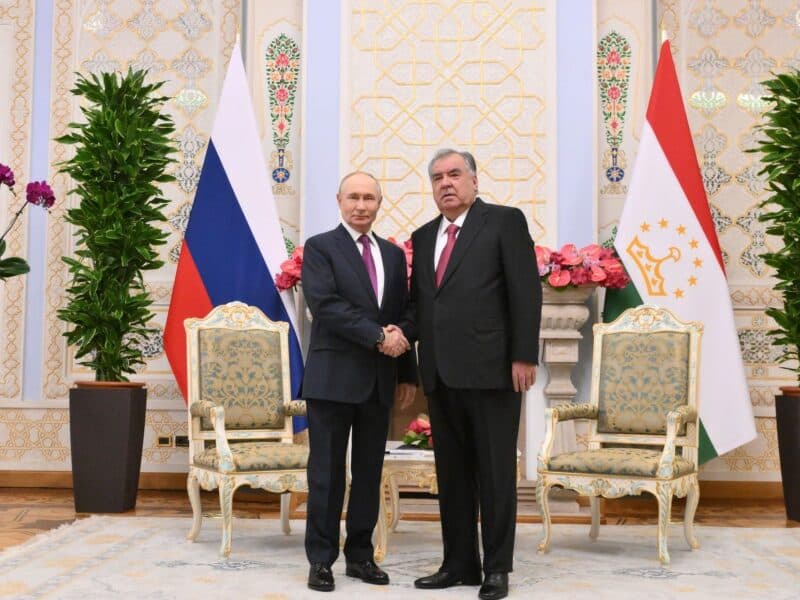
THE HAGUE, Netherlands (CN) — Vladimir Putin touched down in Tajikistan last fall as a wanted man and left untouched, but the fallout from the lack of an arrest escalated Thursday after the International Criminal Court formally handed the dispute to its member states.
Tajikistan told ICC judges it could not detain Putin without violating other international commitments tied to Russia and the Commonwealth of Independent States, arguing that agreements protecting the immunity and movement of heads of state blocked it from acting while the Russian president was visiting.
Judges in The Hague rejected that argument in March and escalated the matter to the Assembly of States Parties, the ICC's governing body made up of member countries.
The Tajikistan referral now moves to the assembly. According to an ICC news release Thursday, Tajikistan was invited to appear before the Bureau of the Assembly on Wednesday to explain its position and discuss future cooperation. The bureau is expected to prepare a report and recommendations for ICC member states, shifting the fight from the courtroom into a more political showdown over how hard the court's members are willing to push one of their own over its refusal to arrest Putin.
Putin has been wanted by the ICC since March 2023, when judges accused him of responsibility for the unlawful deportation and transfer of Ukrainian children from occupied Ukrainian territory into Russia following Moscow's full-scale invasion in February 2022. Russia is not an ICC member and has consistently rejected both the claims and the court's authority.
Tajikistan, however, signed the court's underpinning Rome Statute years ago, putting it under different obligations once Putin arrived in Dushanbe in October 2025 for regional summits tied to the Commonwealth of Independent States and Central Asia-Russia talks.
According to the court, ICC officials spent months trying to avoid the confrontation before the visit. Court representatives met Tajik authorities in July 2025 after reports surfaced that Putin was expected at the summit. The court later followed up through diplomatic channels, reminding Tajikistan it was expected to cooperate and could formally consult the ICC if legal complications arose.
Instead, Tajikistan informed the court in September 2025 that it would not execute the arrest request. Officials argued Russia had not waived Putin's immunity as a sitting head of state and pointed to regional agreements requiring Tajikistan to guarantee the "security and unhindered movement" of CIS leaders. The government also cited what it called "legal obligations and political considerations related to its strategic partnership with the Russian Federation."
ICC judges were not persuaded. They said member countries cannot treat arrest requests as optional under the court's founding treaty, even when the suspect is a sitting president.
The chamber also rejected Tajikistan's reliance on outside agreements with Russia, writing that "the contents and the obligations entered by a state party in any international agreement or treaty, which defeats the object and purpose of the obligations of that state party under the statute is not opposable as a justification for the non-cooperation of that state with the court."
Based in The Hague, the ICC prosecutes genocide, war crimes, crimes against humanity and aggression when national authorities cannot or will not do so themselves. But unlike national courts, it has no police force and relies almost entirely on member countries to carry out arrests, a system that has repeatedly crashed into geopolitical alliances and governments unwilling to detain powerful leaders.
The court has spent years wrestling with that problem. After ICC judges issued arrest warrants for Sudan's former President Omar al-Bashir in 2009 and 2010 over atrocities in Darfur, Bashir continued traveling abroad, including a controversial 2015 trip to South Africa where authorities allowed him to leave despite a domestic court order blocking his departure. He was eventually ousted in 2019 and remains in Sudan, where officials have repeatedly promised cooperation with the ICC but still have not surrendered him to The Hague as of April.
The same tensions have followed more recent cases. In April 2025, Israeli Prime Minister Benjamin Netanyahu traveled to Hungary despite an ICC warrant tied to the war in Gaza. During the visit, Hungarian Prime Minister Viktor Orbán announced his nation would withdraw from the ICC, making it the first European Union member state to leave the court.
Several major powers, including the United States, China, Russia, India, Israel, Saudi Arabia and Iran, do not recognize ICC jurisdiction, leaving the court dependent on countries willing to enforce its warrants even when doing so carries diplomatic consequences.
Courthouse News reporter Eunseo Hong is based in the Netherlands.