Italy loses in push to make one defendant foot bill for entire tax evasion scheme
Europe's top human rights court said Italy crossed the line by forcing some people to absorb massive confiscation orders tied to criminal schemes that generated far more money than they personally received.
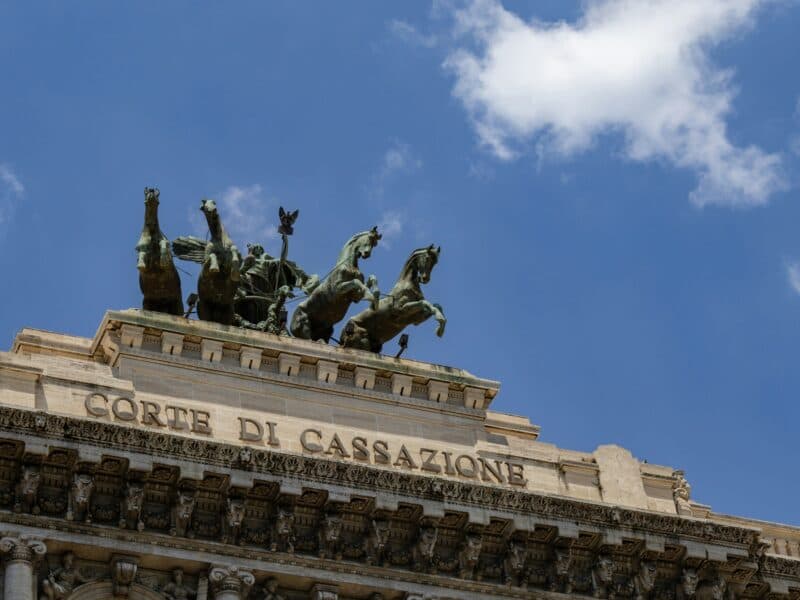
(CN) — Italy's long-running war on tax fraud ran into a problem Thursday at Europe's human rights court: How much can prosecutors seize from one defendant when a criminal scheme involved many people?
Three Italians tied to separate tax fraud and corruption cases challenged a confiscation system that allows authorities to seize assets matching the total profits generated by a crime, even when one defendant personally received only a small share of the money.
One applicant, an accountant accused of helping clients dodge taxes, earned 12,000 euros (about $13,953) but faced confiscation orders topping 5 million euros, or about $5.81 million. Another defendant in a public-contract fraud case lost more than 44,000 euros, or about $51,162, despite saying he received only a fraction of that amount. The largest order hit a Milan tax consultant accused of helping orchestrate a wide tax-evasion scheme, with courts approving confiscation of more than 36 million euros (about $42 million) in assets.
Judges at the European Court of Human Rights split on how far Italy could go in making defendants financially responsible for proceeds tied to wider criminal operations.
The court ruled Italy violated the Milan consultant's rights because the country's judges never clearly established when one defendant could be forced to absorb profits tied to co-offenders, leaving the scale of confiscation liability unpredictable.
Judges also found Italian courts never developed workable standards for dividing confiscation amounts among defendants involved in the same scheme.
"The court is unable to detect, either in domestic law and case-law, any precise criterion for how liability might be shared," the judges wrote.
The other two applicants partly won as well. Strasbourg judges said the confiscation orders imposed an excessive burden because the amounts exceeded what the men personally gained and were imposed automatically under joint-liability rules. The court said Italian authorities had effectively shifted the burden of recovering missing criminal proceeds onto whichever defendants still had assets left to seize.
But judges rejected the men's separate argument that they were effectively being punished for someone else's crimes. Both had accepted plea bargains and admitted participating in the offenses, meaning the confiscation orders still flowed from their own conduct.
"There was therefore a clear link between the applicants' conduct and the confiscation of the entire proceeds of the crime," the court found.
Tommaso Trinchera, assistant professor of criminal law at Bocconi University, said the ruling could reshape confiscation fights well beyond Italy because it pushed back against a broader practice of making one co-offender financially responsible for the entire profits generated by a crime "even when that person did not actually obtain those proceeds."
Trinchera said the judges drew a sharp distinction between confiscation aimed at stripping away unlawful enrichment and confiscation that turns into punishment disconnected from a defendant's own gain or role.
"Once confiscation is recognized as having a punitive character, evidentiary difficulty alone should not justify imposing a financial penalty that is unpredictable and potentially disproportionate," he said.
Italian prosecutors and financial police have spent years chasing tax-evasion schemes involving fake invoices, shell companies and hidden profits, often targeting accountants, consultants and intermediaries accused of helping businesses conceal money or slash tax bills.
Recent investigations have swept up logistics firms, VAT fraud networks and multinational corporations. Italian tax police searched Amazon offices in Milan earlier this year as part of a tax probe, while other investigations targeted labor-outsourcing schemes and organized crime-linked VAT fraud operations.
For years, Italian courts defended broad confiscation powers by arguing criminal profits are often hidden, transferred or depleted before authorities can recover the money directly. Prosecutors also said defendants could later sue co-offenders in civil court to claw back their shares.
Strasbourg judges were not persuaded. They pointed to years of conflicting rulings inside Italy itself. Some courts let prosecutors pursue one defendant for the full gains generated by a scheme, while others limited confiscation to the amount each participant actually received. Italy's highest criminal court only resolved the split last year, ruling confiscation generally should match each defendant's share of the illicit gains.
Michele Panzavolta, professor of criminal law and cybercrime at KU Leuven, said the ruling fit neatly into a broader line of Strasbourg cases faulting Italy for unclear confiscation rules and inconsistent domestic case law.
Panzavolta said the judges treated value-based confiscation as a criminal penalty and took aim at the idea that one co-defendant can automatically be forced to surrender the full proceeds of a crime regardless of the benefit personally received. "It is particularly the lack of clarity of the rules, coupled with inconsistent case law, that has led to Italy's conviction," he said, adding the outcome might have been different if prosecutors had confiscated the direct proceeds of the crimes themselves rather than equivalent assets.
Francesco Menditto, former chief prosecutor of Tivoli, confiscation law expert and board member at Italy's National Agency for Assets Confiscated from Criminal Organizations, said the Strasbourg court ultimately reinforced a principle Italian courts had already begun embracing: Confiscation should restore the financial situation that existed before the offense, rather than automatically forcing one defendant to cover the full proceeds generated by a wider criminal scheme.
Menditto said the ruling also strongly reaffirmed confiscation as a key anti-mafia and anti-corruption tool. In Italy, he said, confiscation orders are often "more feared" than prison sentences because "the sentence is necessarily temporary, whereas the confiscation of assets is definitive."
He pointed to the growing use of confiscated assets for public purposes, including shelters for trafficking victims, disability rehabilitation centers and police stations, saying those properties can carry "added value" once returned to society.
Thursday's judgment does not automatically erase the confiscation orders. But it gives all three applicants a path back into Italian courts under a domestic law allowing criminal cases to be reopened after adverse rulings from the rights court in Strasbourg.
Lawyers for the applicants and representatives of the Italian government did not immediately respond to requests for comment.
Courthouse News reporter Eunseo Hong is based in the Netherlands.