Italy's Ruling Class Has Found Its Plan B
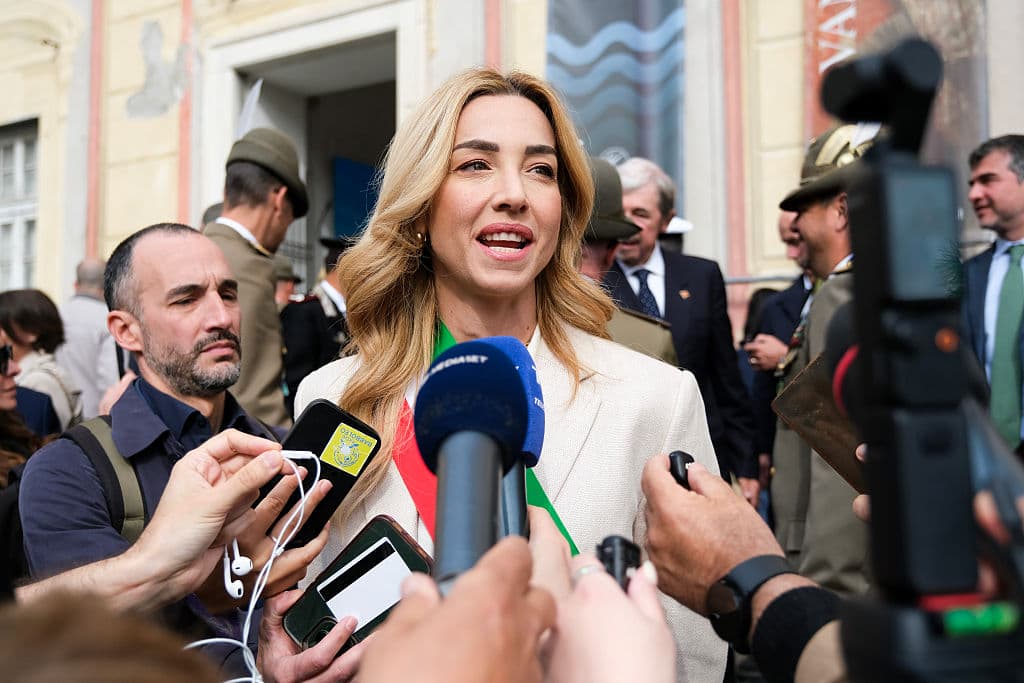
Genoa's mayor, Silvia Salis, is being touted by Italy's liberal press and economic establishment as the natural challenger to Giorgia Meloni. The campaign isn't really about defeating Meloni but about taming the coalition that might replace her.
Almost four years after taking power, Giorgia Meloni's Fratelli d'Italia is still Italy's largest party. Yet in recent months, the polling lead for Meloni's right-wing coalition has been steadily eroded — and political setbacks have now started coming.
In March, voters rejected a planned justice reform in a national referendum. Meloni's once-warm relationship with the Trump administration has also become a liability given the US president's deep unpopularity in Italy, and it has cooled into mild friction as Washington's rift with Europe widens. Recent surveys also show Meloni's base weakening among working-class voters. With national elections due in 2027, it's no longer certain that her right-wing coalition can hold onto power.
This is the political backdrop against which Silvia Salis, a forty-year-old former Olympic hammer thrower, has gone from local mayor of Genoa to anti-Meloni candidate-in-waiting.
This spring, Italy's most influential mass media outlets have run, in close succession, what amounts to a convergent celebration of Salis. Outlets such as La Stampa, Repubblica, Corriere della Sera, and Vanity Fair Italia have produced a steady stream of cover stories, sympathetic profiles, and indulgent interviews. Vanity Fair Italia's April 22 cover even echoed its 2013 portrait of centrist Matteo Renzi, just before he rose to the leadership of the Partito Democratico (PD) and then the prime minister's office.
The international press has also taken its cue from the Italian media. Last month, Bloomberg christened Salis as the "anti-Meloni"; the Guardian depicted her as a progressive icon; and Germany's FAZ cast her as a promising new star of Italian politics.
Yet much of this coverage appears strikingly thin on policy and substance. It is a buildup of hype and vibes that leaves one wondering why so much attention is being devoted to her in the first place. To understand why Italy's mainstream press has suddenly converged on Salis, elevating a little-known local mayor into a front-rank national politician, we need to look at the coalition she is being pushed to lead.
Italy's so-called campo largo (literally, the "broad camp") is, on paper, a familiar liberal-democratic alliance: a big-tent opposition stretching from the centrist liberals of Italia Viva and +Europa to the center-left PD and the Five Star Movement (M5S) to the Alleanza Verdi e Sinistra (AVS). From the perspective of the Italian ruling class, however, it has become a problem.
Elly Schlein, the PD leader, is no firebrand. Still, her left-leaning faction inside the party has weakened the so-called riformisti, the right-leaning current that had long served as the party's preferred interlocutor with industry, finance, and the editorial boards of the major dailies.
M5S has never found much favor with Italy's economic establishment, and under Giuseppe Conte, the party appears too welfarist and unpredictable for the tastes of Confindustria, the country's main employers' federation.
AVS, the most consistently left-wing component of the campo largo, is no longer electorally marginal. It is now polling at about 6 to 7 percent, around the level of Deputy Prime Minister Matteo Salvini's far-right Lega. Despite its moderate-institutional posture and conciliatory style, the AVS remains far from the program desired by the power brokers behind the political system. On Palestine, climate, and labor, it advocates positions the Italian ruling class does not want to see influencing the next government.
If the campo largo wins in 2027, it would do so with a balance of forces tilted further left than the establishment can comfortably tolerate. For Italy's newspaper owners, business elites, and the Confindustria milieu, the strategic question seems to be not how to keep Meloni in power at all costs but how to ensure that, should she be replaced, whoever succeeds her remains acceptable to them.
Salis fits that brief almost too well. She is not, strictly speaking, a politician: she has never sat in parliament, has no previous political career, and entered Genoa's city hall only in May 2025. Her sporting record includes two Olympic appearances and a spell as vice president of the Italian National Olympic Committee. As a "civic" figure with no party affiliation and no left-wing past to defend, she offers a blank surface onto which everyone can project their preferred image.
According to journalistic reconstructions, between late 2023 and early 2024 her name circulated inside Forza Italia — the late billionaire Silvio Berlusconi's center-right party — as a possible candidate, first for the presidency of the Liguria region and then for Genoa's city hall. A more recent reconstruction in Il Fatto Quotidiano, a newspaper usually critical of the political establishment and absent from the chorus of praise surrounding Salis, adds another piece of the picture: in 2024, Salis dined in Genoa with her husband, the film director Fausto Brizzi, and Giovanni Toti, then president of Liguria, a few months before Toti would be placed under house arrest in the corruption scandal that hit him and his right-wing regional government.
After the Toti scandal, the route into center-right politics that had once seemed available to Salis appeared to have closed off, and she was ultimately elected as an independent with the backing of a broad center-left coalition. Marco Bucci — the center-right former mayor of Genoa, whom Salis succeeded, and now president of Liguria — put the case most plainly: "She's a good candidate, she could have been one of ours."
Moreover, in October 2023, Salis quietly registered a personal political brand, "Futuro Democratico," that has since gone unused — a placeholder party kept in the drawer. The Fatto Quotidiano editor Marco Travaglio has compared the move to Berlusconi quietly registering his own party name decades ago even as the media tycoon ruled out any political ambitions.
Salis's personal network tilts the same way. Her husband, Brizzi, is a fixture of Rome's commercial cinema and television world. Her communications consultant is Marco Agnoletti — Renzi's spin doctor during the latter's 2014 takeover of the PD, the operation later symbolized by Renzi's infamous "Enrico stai sereno" reassurance to then Prime Minister Enrico Letta weeks before Letta was pushed out. Some commentators have already begun describing the construction of Salis's national profile as a textbook reprise of the same play: public reassurances of loyalty to PD's Schlein alongside methodical work behind the scenes to assemble the alliance that will displace her.
Renzi himself has openly encouraged Salis's national ambitions. Carlo Calenda, leader of the centrist Azione, has already declared that if the campo largo chooses Salis as its leader, his party would be ready to join the coalition.
The cascade of celebratory coverage is not a string of coincidences. This is what elite consensus looks like when it forms in real time. It does not require a mastermind issuing instructions; a shared interest among the people who own newspapers, finance political campaigns, and decide whose interviews land on the cover is enough. Everything suggests that their interest, in 2026, is preventing the Italian center-left from arriving in office in 2027 with Schlein, Conte, and AVS dictating the terms of the new government.
The Salis operation is thus not really about beating Meloni. The polls already show that the campo largo is roughly competitive with the right-wing alliance; the math does not depend on a candidate who was almost completely unknown a few months ago. The point is to determine who leads that opposition and on what platform — to reorient the coalition's internal balance away from the left wing that has grown stronger and toward a centrist, "civic" leadership fully willing to speak the language of fiscal responsibility, NATO loyalty, and compromise on wages and on climate.
If the Salis operation succeeds, Italians will get rid of Meloni only to be governed by something like a second Renzi administration with a sportier brand — perhaps even, as some commentators suggest, a broadly centrist coalition that brings Forza Italia over from Meloni's right-wing bloc. If it fails, there remains a real, if narrow, possibility for Italy in 2027: a government built around Schlein's PD, Conte's M5S, and a strengthened AVS, which might at least try to pursue a modest social democratic program after many years in which even that has been off the table. None of this would be path-breaking, and it would fall short of the reforms a country in steady decline like Italy needs. But it would still be a step in the right direction, and it may open up new spaces of pressure for bolder reforms.
That is what is actually at stake in the Salis operation. The Italian ruling class seems to have understood it perfectly. The Italian left would be foolish not to.