Justices protect generic drugmaker from patent infringement liability
In a unanimous ruling, Justice Jackson said drugmakers weren't violating the law by truthfully describing a generic drug as equivalent to a brand-name competitor.
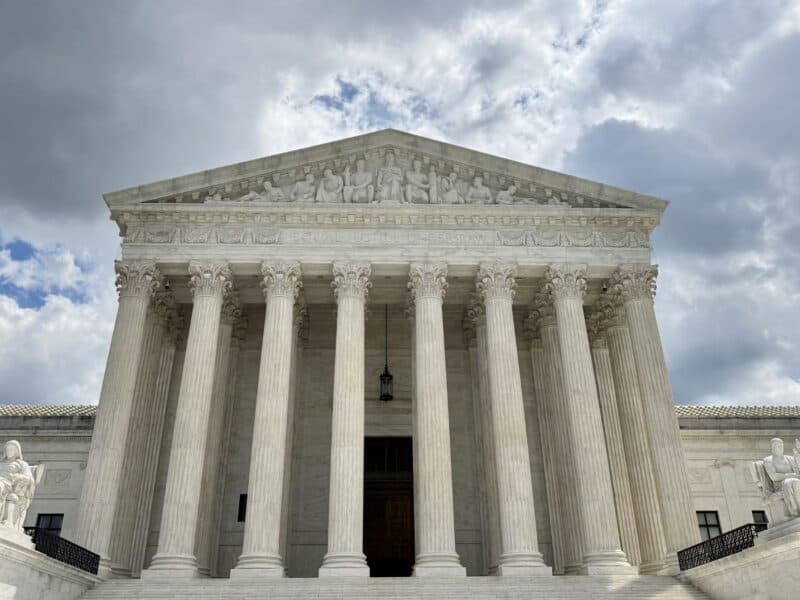
WASHINGTON (CN) — The Supreme Court on Thursday ruled that a generic drugmaker didn't overstep when advertising its product as a substitute for a brand-name pharmaceutical treating heart disease.
Amarin Pharma, the manufacturer of Vascepa, a prescription heart disease medication, sued Hikma Pharmaceuticals, a generic manufacturer of the drug, after pharmacists began dispensing Hikma's product as a substitute to patients who had been prescribed Vascepa.
Under the Food and Drug Administration's skinny-label regulation, drugmakers can obtain approval for generic labels that carve out patented uses from unpatented ones. Amarin claimed that Hikma infringed on its patented uses by advertising its product as a "generic equivalent" of Vascepa.
In a unanimous ruling, Justice Ketanji Brown Jackson, a Joe Biden appointee, said Hikma is obligated to match its medication labels to brand-name drugs in most circumstances. And it is normal industry practice to truthfully describe a generic drug as equivalent to the brand-name comparator.
Therefore, the court held that such actions fell short of patent infringement.
"We decline to put generic manufacturers between a rock and a hard place by turning adherence to the law and industry standards into building blocks for illegal conduct," Jackson wrote.
Amarin cited Hikma's press statements and website information as evidence that Hikma encouraged pharmacists to prescribe the generic drug to patients for patented uses. Amarin claimed in its lawsuit that Hikma was secondarily liable under the Patent Act. A provision of the statute permits liability if a generic drugmaker actively induces the infringement by pharmacies and customers.
But the court found the connection too attenuated. Jackson said Amarin failed to show more than a sheer possibility that Hikma actively induced infringement.
"With a healthy stretch of the imagination, one might believe that some medical providers could read between the lines and draw improper conclusions. … But we look for affirmative 'statements or actions' precisely to avoid 'trenching on regular commerce' based on such a contingent chain of events," Jackson wrote.
To do otherwise, Jackson said, would expose ordinary merchants to liability for any misuse of their goods or services.
Jackson said leaflets for medical providers, website statements and sales figures were too vague to qualify as active encouragement.
However, the court held Hikma's arguments that express inducement was necessary to make a claim were also incorrect. Jackson said implicit or explicit encouragement can qualify as long as the inducement is clear to the relevant audience and affirmative.