'King of the North' Burnham notches decisive UK win, opening path to challenge Starmer
The Greater Manchester mayor's commanding victory clears the way for him to contest the leadership of the Labour Party — and the government.
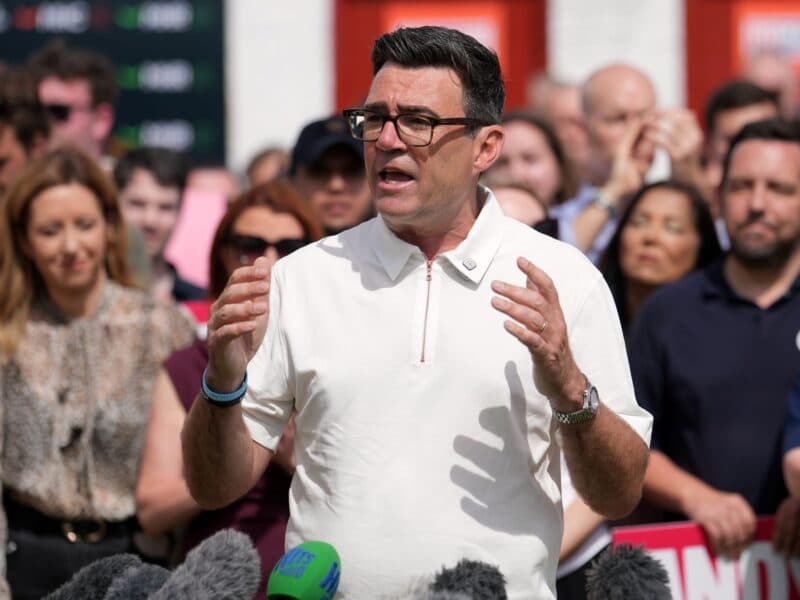
MANCHESTER, England (CN) — Andy Burnham won a large majority in a U.K. special election on Friday, returning him to Parliament and opening a pathway for the former Greater Manchester mayor to mount a leadership challenge against Labour Party Prime Minister Keir Starmer.
Burnham won 24,927 votes, or 55% of the total, defeating the right-wing party Reform UK by more than 9,000 votes in the Makerfield constituency many expected right-wing firebrand Nigel Farage's insurgent party to threaten.
The result marks Burnham's return to Westminster after a decade away and could reshape British politics at a moment when Starmer's authority is under increasing strain. The prime minister is deeply unpopular and has faced calls for his resignation, most recently over his handling of the appointment of Jeffrey Epstein-linked Peter Mandelson as U.S. ambassador.
Before the by-election, Starmer publicly warned Burnham against using a victory as a launchpad for a leadership bid.
On Friday, however, the prime minister struck a conciliatory tone, congratulating Burnham.
He called it "a very good victory" and described the contest as "a real battle of Labour values against divisive Reform values."
"The tide is turning on Reform," Starmer said. "They can't now win by-elections, they've probably reached the peak of their support, it's going down."
Still, he acknowledged the threat to his own leadership.
"If there is a contest, then yes I will run, I will stand, and I've said repeatedly I'm not going to walk away from that," he said.
Under Labour Party rules, Burnham would need support from 20% of Labour lawmakers — 81 members of Parliament — to formally challenge Starmer. Unlike challengers, Starmer would not need nominations to defend his position.
Party members and affiliated organizations would then vote, with a candidate needing to secure more than 50% of votes to become leader.
Although no challenge has been formally announced, Burnham's victory is expected to accelerate conversations already underway within Labour.
More than 90 Labour lawmakers have previously called for Starmer to resign.
Former Health Secretary Wes Streeting, who resigned from Starmer's government last month and has also signaled interest in a future leadership race, called the result an "astonishing victory."
"Makerfield gives us all hope that Labour can still win, but Andy's campaign is proof that to do so we need to change," he said.
The scale of Burnham's victory may strengthen his hand as he weighs a challenge to Starmer's leadership.
More than 45,500 ballots were cast, producing a turnout of 58.8% — the first time since 1982 that a British parliamentary by-election attracted a higher turnout than the previous general election in the same seat.
Reform finished a distant second with 35%.
Restore Britain, the far-right party that won the backing of Elon Musk, picked up 7%, with the Conservatives, the Greens and the Liberal Democrats trailing.
Supporters of the former mayor, who is known as the King of the North, have argued he is the only senior Labour figure capable of defeating Farage's populist movement in northern England. It's a region where Labour has struggled to hold onto working-class voters in recent years.
But Makerfield appeared tailor-made for a Reform upset.
The constituency voted heavily to leave the European Union during the 2016 Brexit referendum, with 65% backing Brexit, and Reform recently swept local elections across the surrounding Wigan area.
The party entered the contest as an underdog but on favorable terrain. Instead, Burnham expanded Labour's vote share by 10 percentage points.
John, a Greater Manchester resident, told Courthouse News the significance of Burnham's victory "can't be underestimated."
He said the result could shape Britain's political direction for years and argued Burnham must now follow through on promises to deliver "a new way of doing politics."
John added he believed a Reform victory in Makerfield would have put Farage's party on course to win the next general election.
Burnham used his victory speech to frame the result as a warning to both Labour and the U.K.
"The country isn't where it should be and tonight could be the turning point," he said.
He called the result "a loud cry for change" and warned Labour it faced a "final chance to change."
"There will be no second chance," Burnham said. "There is an opportunity now to build a new politics based on unity and hope."
Later Friday, speaking to Labour supporters, Burnham outlined a broader economic agenda centered on the cost of living crisis.
"We need an economy that works for everybody," he said, adding that water bills, energy prices and rail fares must fall.
He said Labour must "make life affordable" and "give people more breathing space, so they can have a better life."
Burnham also called for "a new drive of reindustrialization," improvements to education and warned Britain risked following the United States toward greater political polarization.
"Last night's vote carried a risk" of Britain moving toward "greater division," he said, before adding the result had "opened up the possibility we can now move forward together towards that future."
He pledged to set out a "new path for Britain."
Reform leader Farage acknowledged disappointment.
"It's been a disappointing morning," he said. Burnham's victory was "dramatic" and "one nobody could quite see coming."
"I'd thought we'd get 18,000 votes, we got just shy of 16,000 so I'm disappointed by that. No question about it," Farage said.
Reform deputy leader Richard Tice claimed some supporters had voted tactically for Burnham in an effort to force Starmer from office.
"I'm so determined to get Starmer out, I'm going to vote Burnham to ensure that result," Tice said supporters had told him.
Despite the setback, Reform is already turning its attention to another contest Burnham's victory has set in motion.
Because Burnham can no longer serve simultaneously as a member of Parliament and mayor of Greater Manchester, authorities must hold a special mayoral election within 35 days of the office becoming vacant, meaning voters will return to the polls by Aug. 6.
The race will become a test of whether Labour can hold on to local power or if Reform can convert local election momentum into executive power. The Green Party is also expected to target the seat after picking up multiple local seats last month.
Greater Manchester's mayor oversees transportation, housing, policing and regional economic development for nearly 3 million people across 10 municipalities in northern England — powers broadly comparable to those of a metropolitan executive in a large U.S. region.
Housing Secretary Steve Reed warned Labour cannot afford to lose the office.
"We need to focus on making sure that Reform do not take that," Reed said. "The damage they would cause to the whole of the north-west of England if they did that would be incalculable."
Courthouse News reporter James Francis Whitehead is based in England.