King opens Parliament as Starmer fights to hold power
King Charles III outlined a broad domestic agenda and closer EU ties Wednesday, but the speech unfolded against deep uncertainty over whether Prime Minister Keir Starmer can hold onto power.
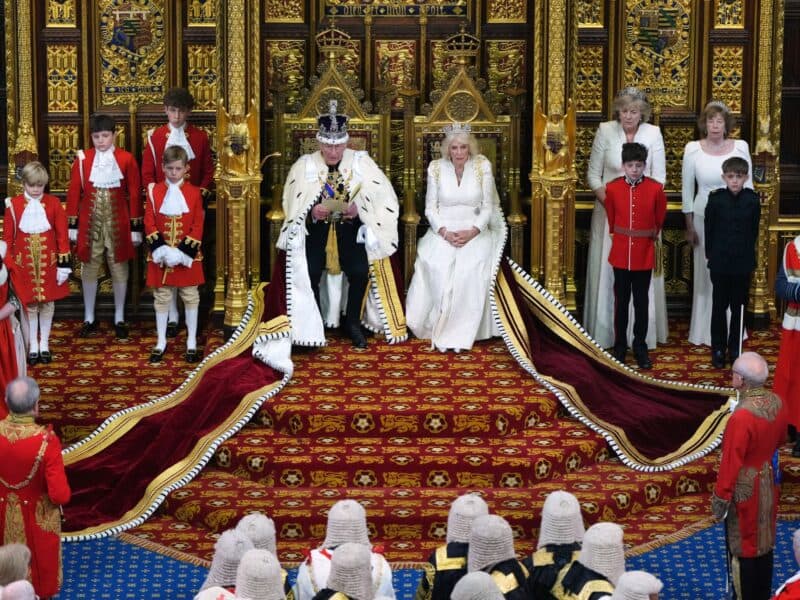
MANCHESTER, England (CN) — King Charles III opened Parliament on Wednesday with a speech laying out Prime Minister Keir Starmer's agenda for the coming year, promising closer ties with the European Union, infrastructure investment and public service reforms, yet doubts continue to mount over whether Starmer's government will survive the week.
The annual King's Speech, a tradition dating back to the 16th century, opens Parliament and sets out the government's legislative plans for the coming session, with the monarch reading plans written by the government.
On a rain-soaked morning that gave way to sunshine, Charles read the roughly 10-minute speech that framed Britain as facing a "dangerous and volatile" world, pointing to conflict in the Middle East and arguing the country's economic future depends on higher living standards and public investment.
"My government believes that the United Kingdom's economic security depends on raising living standards in every part of the United Kingdom," the king said.
The government said it plans to strengthen economic ties with the EU, describing improved trade relations as "vital" and promising legislation to deepen cooperation after years of friction following Brexit.
Charles said Britain would maintain "unflinching support" for Ukraine, pursue a two-state solution between Israel and the Palestinians and maintain what he called an "unbreakable commitment" to NATO through higher defense spending.
The speech also outlined plans to speed up airport expansion, accelerate major road projects and expand rail links in northern England. Ministers pledged to protect domestic steel production.
On healthcare and policing, the king said ministers would pursue reforms to the National Health Service, the police and criminal justice system.
He also confirmed plans for a digital ID system to modernize access to public services and said lawmakers would seek to bolster immigration and asylum security.
The king also said Britain would take over the presidency of the G20 next year and host the 2027 summit.
The speech came amid intense political turmoil for Starmer, whose grip on power appears increasingly fragile after days of resignations and mounting calls for him to step aside from within his own party.
It follows large-scale local election losses for the Labour Party across England, Scotland and Wales.
But Starmer has so far defied calls for him to set out a plan for his departure from No. 10, telling his cabinet on Tuesday that he would "get on with governing" the country.
Four ministers resigned following the cabinet meeting, including former Safeguarding Minister Jess Phillips.
More than 81 Labour lawmakers, the threshold needed to trigger a leadership contest under party rules, have publicly urged him to stand down, though party rebels remain divided over a successor.
Under Labour Party rules, challengers must secure backing from 20% of Labour members of Parliament and unite behind a single candidate.
Health Secretary Wes Streeting, who's on the center-right of the party and widely viewed as a possible rival, briefly met Starmer at Downing Street on Wednesday morning before the speech.
Streeting left after less than 20 minutes.
At the same time, more than 100 Labour lawmakers issued a statement backing Starmer, saying "this is no time for a leadership contest."
Labour currently holds 403 seats.
The opening of Parliament was the first time most Labour lawmakers had the opportunity to see each other since the local elections last Thursday, which could either accelerate efforts to remove Starmer or help to diffuse them.
Labour-affiliated unions added pressure on Wednesday.
Eleven unions linked to the party, including some of Britain's largest that represent roughly 4 million workers, said Labour "cannot continue on its current path" and argued "the results at the election last week were devastating."
In a joint statement, they argued the government was not doing enough to deliver the change it promised for working people, adding that it was "clear that the prime minister will not lead Labour into the next election."
They emphasized focus needed to be put on fundamental economic change, "not on the personalities and unfolding political drama in Westminster."
Wednesday's opening of Parliament followed centuries of royal tradition, which includes the pomp and ceremony seen during President Donald Trump's state visit last September.
Charles traveled with Queen Camilla by horse-drawn carriage from Buckingham Palace to Westminster, while the Imperial State Crown made the journey separately in its own carriage before being rested on the head of the king.
Members of Parliament crowded into the House of Lords, the unelected upper chamber where the monarch delivers the speech because British tradition bars the sovereign from entering the House of Commons, the elected lower chamber.
Whether the government that drafted the speech will remain in power long enough to carry it out could become clearer in the coming days.
Courthouse News reporter James Francis Whitehead is based in England.