Lessons From San Francisco's Fight Against Tech Displacement
A new book recounts how San Francisco tenant organizers took on tech-fueled displacement in the 2010s. Their campaigns were brave, media-savvy, and sometimes successful — but the conditions that made them possible have changed, and so must the strategy.
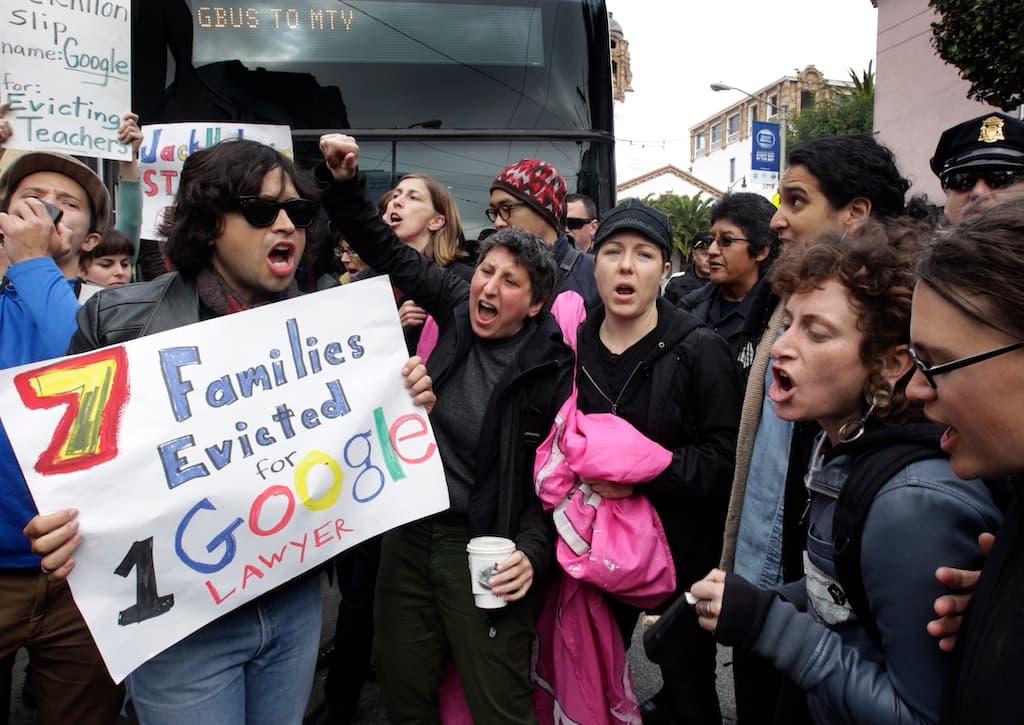
In 2012, a Google in-house lawyer named Jack Halprin bought a 107-year-old Victorian multifamily home — painted all white, with handsome burgundy window trim and a stately, hexagonal turret — for the artificially low price of roughly $1.48 million. Halprin moved into one of the building's seven rent-controlled units, located in San Francisco's historic Mission District, and took the Google bus (a private, corporate-run shuttle) to work. Soon, he decided he liked the arrangement well enough that he wanted the building to himself. He filed eviction notices for everyone else in the building, among them a high-school teacher, first-grade teacher, Uber driver, and elderly disabled woman.
Some tenants moved out; others organized. Their protests quickly drew wide attention. The fact that Halprin worked at one of the major tech firms (Facebook, Apple, Amazon, Netflix, and Google — collectively known as the FAANGs) lent the evictions a broader political meaning. Perhaps most memorably, San Franciscans came together to blockade his Google bus, practically a segregated metro system for tech employees. Many held signs in a mock Google font reading "7 Families Evicted for 1 Google Lawyer" and "Google: Can I Ride Your Bus Back to SF After My Eviction?"
Among the groups behind the campaign against Halprin was Eviction Free San Francisco (EFSF), a media-savvy and seemingly tireless coterie of about five activists, give or take, whose history and practices are rooted in lessons from Occupy Wall Street. San Francisco has a long history of working-class struggle: during the worst of McCarthyism, it became something of a refuge for Communists and fellow travelers keeping a low profile. In the 1970s, as the city underwent a cycle of "Manhattanization," displacing large swathes of Manilatown, the International Hotel (nicknamed the "Red Block") anti-eviction fight set a historic example for the Bay Area tenant movement. And in the '90s, the region's Eviction Defense Network combated Bill Clinton's national push to demolish public housing.
The cycle of struggle in the 2010s, amid the area's second Big Tech boom, was built atop that sedimentary layer: both influenced and enabled by the work others had done, and were doing, across the city's political and legal terrain. From Los Angeles to New York to the Bay Area — three regions with rich tenant movement histories — the post-Occupy moment incited a new wave of partisans, including EFSF.
In Anti-Eviction: The Fight Against Tech-Led Gentrification in San Francisco, Manissa Maharawal considers that moment, filling a critical gap in our understanding of how recent history prefigures current struggle. During the pandemic, tenant organizing exploded across the country, from Houston to Memphis, from South Dakota to North Carolina.
Meanwhile, "as tech oligarchs move to Washington, DC, promising to fix the country's problems with a 'move fast and break things' approach to government," Maharawal contends, Anti-Eviction "offers examples of successful organizing against such structures of power." Part-ethnography, part-historical guide, Anti-Eviction aims to both counter right-wing narratives of San Francisco's post-pandemic "doom loop" and highlight the extraordinary bravery — and extraordinary risk — involved in tenants' resistance to displacement.
Maharawal is the founder of the oral history wing within the Anti-Eviction Mapping Project (AEMP), which launched in 2013 and documents dispossession and resistance through maps, data visualization, and storytelling. It's arguably the most sophisticated venture of its kind. In 2018, the group even sparred with Princeton's Matthew Desmond, of Pulitzer Prize–winning Evicted and Eviction Lab fame, accusing him of working with real estate–aligned groups and presenting incomplete data.
AEMP's immediate goal was to provide "vitally important counterpoints to the spatial hoarding of wealth and power," as renowned geographer Ananya Roy described it, contrary to the stories told by real estate boosters or allied commentariat. In 2021, the group published Counterpoints, an atlas rigorously detailing Bay Area working-class life and turning rote understandings of displacement, segregation, and placemaking on their head. Anti-Eviction picks up where Counterpoints left off, offering the first book-length reflection on AEMP's founding and EFSF's organizing. (AEMP and EFSF have a bit of a square/rectangle relationship: one doesn't wholly equal the other, but there's significant overlap.)
Yet invigorating as the narrative often is, a current of grief runs through the book — often buried in the endnotes. Barring the occasional victory won on a legal technicality, most San Francisco tenants "were fighting losing battles," Maharawal cedes, and San Francisco today is "what happens to cities in the aftermath of tech-led gentrification." Finally, on the last page of the last chapter, she reveals that EFSF had dissolved in 2017. (Counterpoints dates the group's end to 2016, promising to one day anthologize "our experiences, successes, and failures.")
It's common for tactics and all-volunteer groups to "ebb and flow in this way," Maharawal continues in the endnotes. When core members moved away "for personal reasons" or were displaced, it proved impossible to sustain. But things ebb and flow for a reason, no matter how neutral the process may seem. We must take the dissolution of EFSF seriously and ask what more durable and consistently successful organizing strategies might look like. Anti-Eviction does indeed offer examples for organizing today, but they may not be precisely the right ones to emulate — or, at least, not in the current context.
"We Are Still Here" is a fitting title for Maharawal's conclusion, even though she and Erin McElroy (cofounders of AEMP and EFSF) have both relocated to DC and Seattle, respectively, for academic jobs. (Though both still visit and keep in touch with San Francisco activists.) "People are still fighting for these tenants," Maharawal writes, "even amid the boom-and-bust cycle of tech wealth, even while the city is characterized as 'done' or 'over' and caught in a 'doom loop.' The lesson is that organizing and caring for one another keeps people in their homes."
Identifying the organizations and strategies that have succeeded EFSF is beyond Anti-Eviction's scope. Still, connecting EFSF's rise and fall to the strategic shifts among tenant organizers in San Francisco today, in the "aftermath of tech-led gentrification," may be instructive for much of the country, given that tech has already needled its way into a range of midsize cities, from Austin to Asheville and Miami, to say nothing of the national aspirations it's pursuing in Washington, DC.
One such shift is the newer tenant movement's effort to separate superficial cultural grievances from deeper power structures. "I think there are critiques to be made about the ability of [San Francisco's] housing justice movement to clearly articulate the structural elements of tech and real estate collusion versus the sort of lifestyle elements of tech gentrification," Molly Goldberg, director for the San Francisco Anti-Displacement Coalition, told me. Those lifestyle elements are hard not to fixate on, but keeping things grounded on a personal level obfuscates the structural features of the collusion between tech and real estate capital.
Goldberg, who appears in Anti-Eviction's acknowledgments, said the 2010s were marked by "popular clarity" around the who of gentrification: it was a moment of "very targeted, very personally felt speculative behavior" against long-time, typically rent-controlled tenants who were "beloved in the community." The people doing the onslaught were rich techie transplants. And so the cultural battle lines were set, politically symbolizing the broader pressures people felt across the region.
EFSF leveraged this dynamic effectively to win popular support for tenants' demands. As Maharawal recounts, each of Halprin's encroachments on the building's shared space — installing security cameras trained on people's front doors or informing tenants they were no longer permitted to use the backyard — were "experienced collectively" as infringements on the social fabric. EFSF, which relied on a tenant-mobilizing model, didn't just spotlight Halprin as a villain: the group also developed campaigns around individual tenants as heroes. The strategy was aimed at grabbing media attention and leveraging popular support for longtimers into a range of concessions.
In the end, Halprin's tenants won, albeit in a manner outside their immediate control. In 2015, Halprin unexpectedly died. He hadn't left a will, which threw the property into legal limbo. His mother eventually inherited it and opted not to pursue evictions. EFSF got what it wanted but not in the way anyone expected.
I described this to Goldberg as "kind of a legal fluke," but she pushed back. "Tenant protections are self-enforced," she said, noting that the city often doesn't pursue enforcement without strong pressure from tenants. "A lot of times, tenant organizing is about ensuring people stay long enough to develop leverage until the landlord, weighing the costs, chooses to move on." In that sense, Halprin's tenants' victory was their own.
In the 2010s, says Goldberg, "where individuals were acting as speculators, that kind of capital was less patient." It was easier to make a villain out of a landlord, protest them, and wait them out until they got tired and gave up.
Not so today. "What we're seeing is not just independent investors buying two or three buildings, or even small-time slumlords with ten to twenty properties," said Fred Sherburn-Zimmer, a San Francisco housing organizer of over twenty-five years. "Instead, we're seeing these huge corporations backed by private equity just swallowing up most large buildings in the city."
Sherburn-Zimmer is a former EFSF member and frequently appears in Anti-Eviction. One of the problems with the EFSF model, she told Maharawal, was that the bedrock legal and political protections for tenants had actually gotten people "used to just going to city hall for things." EFSF was, on the one hand, permitted to operate as a highly specific eviction-defense committee because of the housing advocacy ecosystem that preexisted the organization. But on the other hand, carving a new path away from the advocate model proved difficult.
Today much of the energy in San Francisco tenant organizing is around building portfolio-wide tenant associations. "Different problem, different tactics, right?" Sherburn-Zimmer said. The aim is to intervene earlier — EFSF typically got involved after eviction papers were filed — and create the kind of long-lasting organizations that could give any landlord trouble, no matter how or when the property changes hands. It's a model other groups are experimenting with, from New York (where the Union of Pinnacle Tenants organized across several boroughs, linking properties up for sale amid Pinnacle Group's massive bankruptcy proceedings) to Los Angeles to the nationwide Tenant Union Federation (TUF), whose project is explicitly to build the power necessary "to bargain for tenant protections."
This model is not without its own problems. Whether a federated structure can as effectively spread to those areas without the necessary layer of tenant protections, shared memory, and legal precedent remains an open question. In 2023, a handful of former tenant unionists in Durham, North Carolina, concluded — perhaps too soon — that "in gentrifying cities within red states, the tenant union strategy is not the path to housing justice," because Republicans have imposed fierce preemption laws on Democrat-controlled cities, limiting the possibility of municipal reforms.
Moreover, when Pinnacle tenants (or tenant unions like theirs) are no longer, strictly speaking, "Pinnacle" tenants, the fear I've heard from multiple organizers is that tying a union's identity to a specific landlord may inadvertently bind the organization's horizons to the landlord's fate.
"So far, no model has been able to stop mass displacement," said Julian Francis Park, a contributor to the Counterpoints atlas and member of the Tenant and Neighborhood Councils of the Bay (TANC). This isn't to say there's no hope, only that there's still experimenting to be done. TANC, a project born out of Democratic Socialists of America's Communist Caucus, encourages its local chapters to try different tactics based on the neighborhood's distinct needs and interests — linking the councils' identity to specific regions, rather than landlords. "The recent shift in organizing is partly a reckoning with the fact that this needs to be a longer-term struggle," Park said. "We need to have a broader, united base."
We must address the elephant in the room. As EFSF activists blockaded buses, invaded landlords' offices, and protested outside city hall, another Bay Area movement was born: the YIMBY movement. In an exhaustive 2025 study, the Federal Reserve Bank of San Francisco — not exactly the Daily Worker — found that "housing supply constraints are unimportant in explaining differences in rising house prices among U.S. cities" because higher income growth "predicts the same growth in house prices, housing quantity, and population regardless of a city's estimated housing supply."
In other words, in cities like San Francisco or Austin, where income growth exploded, so, too, did housing prices, even if supply increased in kind. Moreover, as longtime UC Berkeley professor Richard A. Walker pointed out, San Francisco in the 2010s saw housing construction peaks higher than the supposed golden age of the 1960s.
"The key breakpoint in housing supply appears to be 1990," due in large part to financialization and the consolidation of the construction industry, "not 1970," the decade YIMBYs point to as the turning point due to increased environmental regulations. "Clearly, zoning is part of what causes the speed of housing construction to fluctuate," Park told me. "But it's going to be larger economic conditions to a greater degree that determine whether there's further investment for the displacement cycles."
Goldberg said the YIMBY movement's "counterorganizing efforts" were "an explicit attempt to co-opt racial justice frameworks and redefine the enemy and the source of the problem away from capital and toward each other." That "popular clarity" around the who of gentrification all but dissipated, turning neighbor against neighbor.
Not for nothing, the YIMBY movement was backed by real estate cash and eventually expanded to include tech funding. The NIMBY pejorative became a strawman grouping affluent white homeowners with low-income, often non-white tenants in rent-burdened neighborhoods. Still, "Our fault as a movement was spending our time dealing with YIMBYs like they were the enemy," added Sherburn-Zimmer, "not just the lobbying arm of the enemy."
For the time being, the YIMBYs have won the argument. Even Zohran Mamdani, a generally pro-tenant mayor, has apparently accepted simplified supply-side housing economics into his heart. But "the market alone cannot solve the housing crisis," Maharawal writes. Much has changed since the 2010s, but this much remains true.
"It is only going to get worse," Sherburn-Zimmer told me, "unless we can organize to scale."