New York trip scandal triggers biggest political crisis yet for Argentina's Milei
Manuel Adorni, one of the president's top aides, recently resigned after a whirlwind of corruption scandals, undermining the libertarian promises of beating the political caste.
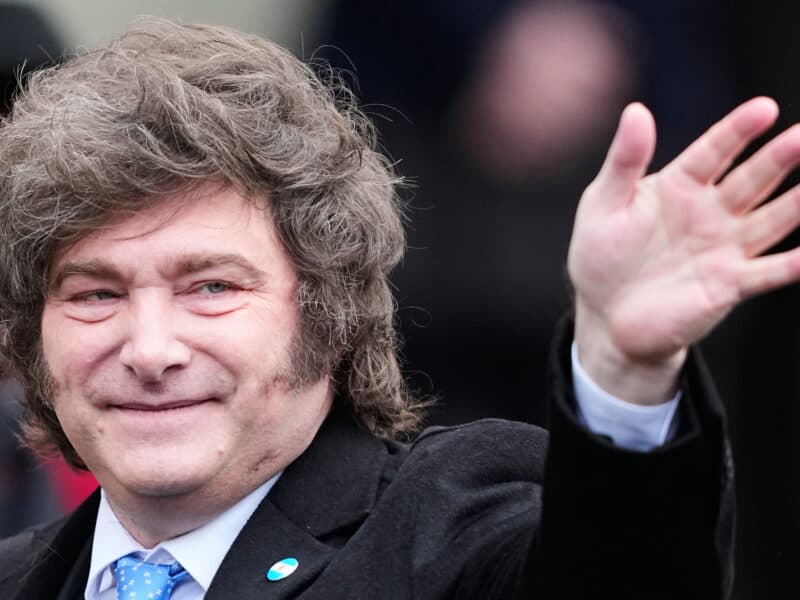
For Javier Milei's government, the biggest political crisis of its presidency began with what looked like an ordinary trip to New York.
Manuel Adorni, Argentina's then-chief of staff and presidential spokesman — one of Milei's closest advisers and among the administration's most recognizable faces — was photographed with his wife, Bettina Angeletti, during Argentina Week, a business summit held in New York City in March. Most senior Argentine officials had traveled to the city for the event, but Angeletti held no public office.
Questions quickly spread through Argentine media and social networks, demanding to know if Adorni's wife had traveled using public funds. Under pressure, Adorni's response only fueled the controversy. "I'm here for a week breaking my back working in New York," he said. "I wanted her to accompany me."
What began as questions over a plane ticket soon spiraled into the scandal that ultimately forced Adorni's resignation after just 100 days as chief of staff.
Investigators began examining accusations of illicit enrichment, undeclared assets and illegal gifts, while journalists uncovered a string of lavish expenditures that seemed difficult to reconcile with the salary of a career public official: a family vacation aboard a private jet, hundreds of thousands of dollars in cash payments, a luxury home renovation featuring an artificial waterfall beside a swimming pool and nearly half a million dollars purportedly omitted from mandatory asset declarations.
Week after week since March, Argentine prosecutors and investigative reporters added new details to the case. Unlike many of Argentina's traditional political figures, Adorni had never built a business empire or inherited significant wealth. Before joining Milei's administration in late 2023, he worked in television and radio and, at one point, in a car dealership. His government salary was roughly $2,000 a month.
Yet prosecutors say during his time in office he spent roughly $245,000 in cash renovating his home while taking luxury family vacations to Caribbean destinations — expenditures they argue are inconsistent with his declared income.
The accusations landed at an especially delicate moment. More than two years into Milei's aggressive austerity program, millions of Argentines are still grappling with shrinking purchasing power, cuts to public spending and the painful consequences of one of the country's deepest economic adjustments in decades.
Against that backdrop, reports of cash renovations, luxury travel and expensive home improvements struck a nerve, feeding a perception that ordinary Argentines were being asked to make sacrifices while one of the government's most visible officials appeared to be living by different rules.
For Milei, however, the scandal represented something larger than the fate of a single official. The libertarian economist won Argentina's presidency promising to destroy what he called "the political caste" — an entrenched class of politicians accused of enriching themselves while ordinary Argentines suffered recurring economic crises. His appeal rested on the idea that political outsiders would govern differently.
And that message resonated far beyond Argentina. Milei has become one of the most closely watched far-right leaders in the world, embraced by conservatives in the United States as evidence that anti-establishment politics and free market economics can succeed in government. His close relationship with U.S. President Donald Trump has further elevated his standing among American conservatives, making Argentina something of a political laboratory for a broader movement skeptical of traditional political institutions.
The Adorni affair threatens that narrative: According to polling by political analyst Lara Goyburu, approval of Milei's administration fell sharply from 46.8% in February to 37.2% in April, when the accusations first surfaced. While support later stabilized, disapproval continued climbing, reaching 58% in June — the highest level since the administration took office.
"The government didn't lose its hard core of supporters, but it lost the entire gray area," Goyburu said. "The undecided voters who had previously given it the benefit of the doubt have now taken sides, and generally they've taken sides against it."
The numbers also suggest the scandal has widened the gap between the government's loyal base and everyone else. Among Milei supporters, backing for Adorni actually increased as the controversy deepened, with many rejecting calls for his resignation. But outside that core electorate, confidence steadily deteriorated. The share of Argentines who said corruption was undermining their trust in the government climbed from 59.4% in April to more than 71% by June, according to Goyburu's polling.
Throughout the controversy, Adorni maintained he did nothing wrong. Rather than responding in detail to each accusation, he argued that he and his family had become victims of a coordinated campaign by political opponents and hostile media — a narrative Milei repeatedly echoed while publicly standing by one of his closest allies.
In his resignation letter to the president, Adorni thanked Milei for accepting his decision, writing it was the first time since taking office that he had acted against his wishes.
"The endless media attacks I've endured have led me to ask you to stand by me this time, so that I can close this chapter in order to protect myself and my family," he wrote, still insisting the accusations were fabricated.
"They have called me a criminal and corrupt without a single act of corruption behind me," he added, and concluded that the "persecution" had shown him his own limits. His resignation did little to quiet the political debate — for Goyburu, the scandal's lasting significance lies not in the accusations themselves but what they represent for Milei's political identity.
"Corruption has become the second-most frequently mentioned problem facing the country, just behind inflation," she said. "For someone who built his political identity on fighting the political caste, having corruption compete head-to-head with inflation strikes directly at the founding narrative of his presidency."
The analyst cautioned against overstating the political damage. Despite months of negative headlines, Milei remains one of Argentina's most popular politicians, and his approval ratings still compare favorably with those of opposition leaders.
"The damage is real," Goyburu said, "but he still occupies political ground that is comparatively less punished than the rest of Argentina's political class."
Whether the Adorni scandal ultimately changes Argentina's political future may not become clear until voters head to the polls next year, but it has already exposed a challenge facing anti-establishment movements well beyond Argentina.
The promise of the government he took part of up until last weekend was not simply to govern more efficiently, but more honestly. For Milei, whose rise inspired like-minded conservatives from Washington to Madrid, that promise has now become harder to defend.
Lucía Cholakian Herrera is a Courthouse News correspondent covering Latin America. She is based in Buenos Aires, Argentina.