Rights court finds Italy shut Jehovah's Witnesses out of religious funding system for decades
Europe's top human rights court criticized Italy for unlawfully keeping the group outside a scheme that opens the door to public funding enjoyed by many other religious groups.
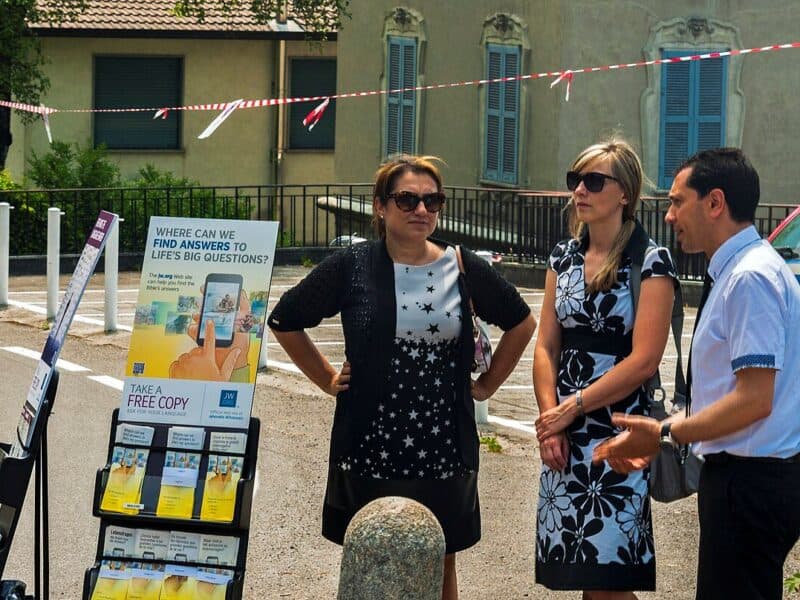
(CN) — Jehovah's Witnesses spent decades knocking on the door to Italy's religious funding system, and Europe's top human rights court said Thursday the country had no good reason to keep it closed.
The Christian Congregation of Jehovah's Witnesses turned to the European Court of Human Rights after decades of trying to secure an intesa, a special agreement that unlocks legal and financial benefits. Since World War II, Italy has gradually extended those agreements beyond the Catholic Church to a range of minority faiths. Completing the process opens access to the "otto per mille" scheme, which allows taxpayers to direct eight-thousandths of their income tax to the state or approved religious groups.
Jewish, Lutheran, Buddhist, Hindu and Mormon communities are among the 13 minority denominations that have done so. Jehovah's Witnesses reached the signing stage several times but never made it across the finish line. The denomination argued that years of delays and official inaction left it at a disadvantage compared with other faith groups and violated its rights to religious freedom, equal treatment and property.
The European Court of Human Rights agreed.
Jehovah's Witnesses have been legally recognized in Italy since 1986. Agreements negotiated with successive governments were signed in 2000, 2007 and 2014, but none received parliamentary approval. Negotiations eventually stalled altogether, leaving the denomination shut out of benefits available to other religious groups.
"The court could not fail to observe that this context placed the applicant in a situation of uncertainty and deprived it of sufficient safeguards against the risk of discriminatory treatment," the judges wrote.
Countries are not required to create special arrangements for religious communities, the court said. But once they do, access to the resulting benefits cannot be left to a process vulnerable to arbitrary treatment.
The judges pointed to several weaknesses in Italy's intesa framework. The procedure is governed largely by administrative practice rather than legislation, with no formal deadlines, no requirement to explain refusals and no effective way to challenge prolonged inaction.
Italian authorities argue that concerns linked to Jehovah's Witnesses' beliefs, particularly their opposition to blood transfusions, justified the failure to complete the process. Government lawyers also point to positions associated with the denomination on blood donation, military service and voting.
The court was unconvinced. Italian authorities had examined those issues repeatedly over the years, continued to recognize the denomination and repeatedly negotiated agreements with it. Nothing presented by the government showed that the group's beliefs posed a threat serious enough to justify different treatment.
The judges also reaffirmed a long-standing principle of European religious-freedom law: "Except in very exceptional cases, the right to freedom of religion excludes any assessment by the state of the legitimacy of religious beliefs or the ways in which those beliefs are expressed."
Marco Ventura, a law-and-religion professor at the University of Siena, said the ruling reflects a paradox in Italy's church-state system.
"I do not know of any other European country who has been as successful as Italy in modernizing its church and state system after WWII," Ventura said. That success, he argued, eventually exposed the system's limits. As legal recognition and public benefits expanded to a growing number of faiths, excluding others became increasingly difficult to justify.
Ventura said the judgment also carries a broader lesson for Europe's treatment of religious minorities often dismissed as "cults." "Just like the Church of Scientology and many others, Jehovah's Witnesses belong here, and are entitled to the same rights," he said.
For Shane Brady, counsel for the Jehovah's Witnesses, the significance of the ruling lies less in the denomination itself than in the process that kept it out. He noted that the Strasbourg court could identify no other regularly registered religion in Italy that had been unable to secure an agreement with the state.
"Italy's agreement system rests on no statute, sets no time limit, requires no reasons for a refusal and is shielded from judicial review," Brady said. "The court held that such a system inherently carries a risk of arbitrariness."
He said judges also rejected the government's attempts to justify the denomination's exclusion based on its beliefs.
Several legal scholars said the judgment does not create a right for religious groups to obtain an agreement with the state. Francesco Alicino, a professor of law and religion at the University of LUM and constitutional law scholar, said judges instead focused on whether access to the legal and financial benefits attached to those agreements is governed by transparent and non-discriminatory rules.
Maria d'Arienzo, a professor of ecclesiastical law at the University of Naples Federico II, likewise said the ruling leaves political discretion intact while requiring decisions to be based on "clear, foreseeable and non-discriminatory criteria."
Pierluigi Consorti, a law professor at the University of Pisa, said the deeper problem was institutional paralysis. Governments repeatedly negotiated and signed agreements with Jehovah's Witnesses, he noted, yet Parliament neither approved nor formally rejected them.
"The problem, therefore, is not political discretion as such, but the transformation of political discretion into institutional inertia beyond effective control," Consorti said.
Human Rights Without Frontiers chairman Willy Fautré welcomed the ruling as a correction of what he described as decades of discriminatory treatment. He noted that Jehovah's Witnesses are among Italy's largest religious communities, with more than 251,000 full members and over 458,000 practitioners.
Fautré said the decision strengthens the denomination's position in seeking access to Italy's main mechanism for public funding of religions. Religious groups without an agreement, he explained, cannot appear on taxpayers' forms or receive funding through the scheme.
The Italian government did not respond to a request for comment.
A unanimous seven-judge chamber agreed, finding that Italy violated the prohibition on discrimination when read alongside protections for religious freedom and property rights. The court awarded the group 10,000 euros (about $11,500) in nonpecuniary damages and 8,000 euros (about $9,200) in legal costs.
Thursday's ruling is not yet final. Either side may ask for referral to the court's Grand Chamber within three months. If no referral is accepted, the judgment will become final, leaving Italy with a damages bill and an uncomfortable question: Why a religious community recognized by the state for four decades still sits outside the country's main system of religious funding.
Courthouse News reporter Eunseo Hong is based in the Netherlands.