Starmer resigns as UK prime minister, triggering leadership race
Just two years after a landslide election victory, Prime Minister Keir Starmer announced his resignation, leaving Great Britain to seek its seventh leader in a decade.
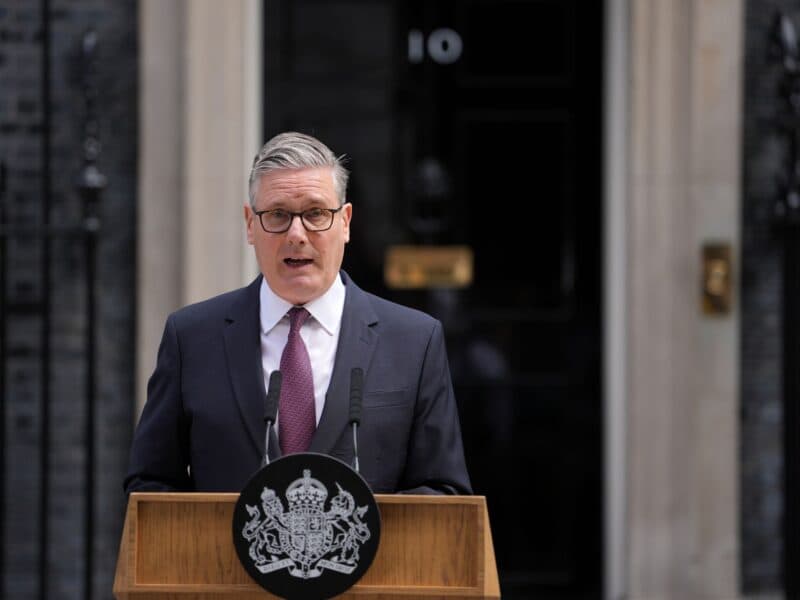
MANCHESTER, England (CN) — British Prime Minister Keir Starmer announced on Monday he will resign as Labour Party leader and step down after two turbulent years in office, ending a premiership that began with a historic parliamentary majority but unraveled under mounting political pressure and public dissatisfaction.
Standing outside 10 Downing Street on a sweltering Monday morning, Starmer acknowledged he had lost the confidence of his own party.
"The question my party is asking now is whether I am best placed to lead us into the next general election," Starmer said. "I have heard the answer of my parliamentary party to that question, and I accept that answer with good grace."
"Every decision I've taken has been about putting the country I love first. That is why I will resign as leader of the Labour Party," he said.
Starmer said he will remain prime minister until his successor is chosen.
Nominations for a leadership contest will open July 9, with a new leader in place before Parliament returns in September.
"I will do everything I can to ensure an orderly handover of power," he added. "I will give my successor my full support."
Attention now turns to a question dominating Westminster: contest or coronation?
The clearest front-runner is Andy Burnham, the former Greater Manchester mayor whose special election victory on Friday and strong national profile have paved a way to Downing Street.
As Starmer delivered his resignation speech, Burnham was in Manchester packing up his belongings from his former mayoral office before traveling to London to be sworn in as the new member of Parliament for Makerfield after winning last week's by-election.
Burnham formally announced his intention to run following Starmer's announcement, thanking the prime minister for his "leadership and dedication during such a challenging period" and calling for an "orderly and responsible" transition.
"The country expects stability, seriousness and a continued focus on the issues that matter most and that is what it will get," Burnham said in a statement posted to social media.
Burnham said Labour must focus on economic growth, the cost of living, public services, housing and opportunities for younger generations, adding that the leadership transition should become "a positive process of renewal for our party and our country."
The scale of Burnham's victory has strengthened perceptions among Labour lawmakers that he is best positioned to confront the growing threat posed by Reform UK, the right-wing populist party that has surged in national polls.
Still, a leadership contest remains possible.
Wes Streeting, who resigned as health secretary last month, had publicly declared his intention to run. But following Burnham's announcement to run, Streeting said he will back Burnham to become Labour leader and prime minister.
If Burnham runs unopposed, he could become Britain's next prime minister around July 17.
The resignation marks a dramatic end to a government that entered office in July 2024 with one of the largest Labour majorities in decades and a promise to restore stability after years of Conservative turmoil.
Instead, Starmer became the latest casualty in an era of rapid political turnover in Britain.
The U.K. has now seen six prime ministers leave office in the past decade and five resign before completing a full parliamentary term: Theresa May, Boris Johnson, Liz Truss, Rishi Sunak and now Starmer.
The pace of turnover reflects a broader trend affecting many democracies, where leaders are struggling to maintain popularity amid economic pressures, rising anti-establishment movements and increasingly fragmented electorates.
Starmer highlighted his achievements Monday, including cutting National Health Service waiting lists, expanding rights for workers and renters, increasing defense spending, reducing small boat crossings across the English Channel, closing asylum hotels and introducing measures to protect young people from social media.
But a series of policy reversals and political misjudgments steadily eroded Starmer's authority, driving down poll numbers, alienating Labour lawmakers and voters and contributing to heavy local election defeats.
His government abandoned unpopular proposed cuts to winter fuel payments for pensioners, plans for mandatory digital identity cards and reductions to disability benefits.
The latter triggered one of the biggest rebellions of his premiership, with 100 Labour lawmakers urging the government to reverse the cuts.
More than 90 Labour lawmakers had publicly called for Starmer to resign in recent months.
His decision to appoint Peter Mandelson as Britain's ambassador to Washington also became a persistent source of controversy and raised questions about Starmer's political judgment.
U.S. President Donald Trump preempted Starmer's speech with a social media post on Sunday, saying Starmer "will resign as Prime Minister" and said he "failed badly on two very important" subjects: immigration and energy — despite official figures showing net migration has fallen significantly in recent months.
Together, the setbacks fueled a growing sense within Labour that the party needed a new leader before the next general election.
Toward the end of his speech, Starmer's voice cracked and his eyes reddened.
"When I leave the biggest job in the country, I shall spend more time on the most important job, being the best husband I can to my fantastic wife Vic, who has been a rock by my side through good times and bad, and being the best dad I can to my beautiful children who are my pride and my joy," he said.
The next question is whether Burnham will face a contest or be handed the leadership unopposed.
Whoever emerges victorious will inherit one of the largest parliamentary majorities in modern British history and immediately become prime minister without a national vote.
That prospect is likely to fuel calls from opposition parties for an early general election, arguing that a new prime minister should seek a fresh democratic mandate from voters.
Courthouse News reporter James Francis Whitehead is based in England.