Supreme Court lets White House ballroom move full steam ahead
Trump claims the project is already 65% complete, despite arguments from a historical preservation group that say it won't be usable for years.
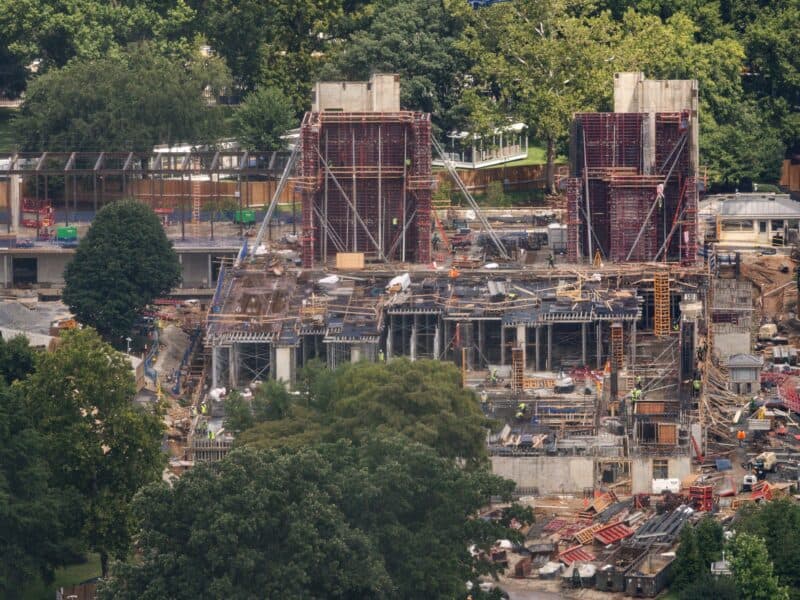
WASHINGTON (CN) — The Supreme Court on Monday cemented President Donald Trump's effort to move forward with construction on the White House ballroom without congressional approval.
Two lower courts put the above-ground portion of the project on hold amid a challenge from the National Trust for Historic Preservation. But Trump asked the justices to overrule the temporary pause, citing national security concerns and judicial overreach.
Chief Justice John Roberts, a George W. Bush appointee, granted an administrative stay Aug. 21 allowing construction to continue while the justices considered whether to uphold the preliminary injunction.
Last year, Trump took unilateral action to demolish the East Wing of the White House, touting construction of a 90,000-square-foot structure to host VIP guests during large events. Trump pitched the project as a solution to the previously used "large and unsightly tent" typically erected on White House grounds for events like state dinners.
The National Trust sued the administration in December 2025 to halt the project. The group, which was chartered by Congress in 1949 to facilitate public participation in the preservation of historical sites, claims the White House is abusing its authority under federal statutes governing ordinary maintenance and repairs on the executive building.
In response, the White House has stressed national security concerns necessitating the project, pointing to a massive military complex being built underneath the ballroom. The administration said these renovations include bomb shelters, medical facilities and other reinforcements to protect the president and other senior officials from threats ranging from drone strikes to chemical attacks.
Under a "safety-and-security exception," two lower courts allowed continued construction on the bunker while keeping the ballroom portion on hold during ongoing litigation.
But Trump pushed the Supreme Court to lift the injunction, arguing the project is already 65% complete. According to the White House, a 250-person crew is working 20 hours a day, seven days a week, and Trump claims there would be no way to take down or alter the project even if the court ordered him to do so.
The government railed against judges trying "to seize control of construction at the president's home and office," arguing the justices should allow the project to continue "for the sake of the president's safety, the continuity of government, and the separation of powers."
The National Trust rebutted Trump's claims, insisting the ballroom wouldn't be usable for years. And the nonprofit says Trump shouldn't be able to exercise emergency powers to convert an "illegal project" to a done deal before courts can review it.
Because the Constitution gives Congress authority over federal property, the National Trust said the president can't unilaterally alter the iconic building. Therefore, the nonprofit claims Trump should have asked lawmakers for permission to build his ballroom, not the justices.
According to the government, Congress authorized presidents to conduct White House renovations under a statute appropriating funds for the upkeep of the executive residence. Last year, lawmakers allocated almost $2.5 million for required maintenance.
In July 2025, the White House estimated the project would cost $200 million and be completely funded by private donors. Over the subsequent months, the price tag of the ballroom ballooned, ratcheting up to around $400 million by the president's own estimates.
The White House maintains zero taxpayer money will be spent on the ballroom. According to Trump, the project will be funded by $400 million in private donations.
But the total cost of the project could reach $600 million, according to records obtained by the Washington Post that found taxpayers would foot over half of the bill. While the White House released a list of 37 donors who contributed to the project, the contributions — collected by the park service and transferred to the executive residence — have mostly been kept out of the public eye.
Additional reporting revealed Trump's total White House construction costs — including construction of a helipad, new visitor screening area and upgrades to Lafayette Square — could exceed $900 million.