The Labour Party's Main Problem Isn't Losing Voters to Reform
Labour lost many seats and councils to Reform in the recent UK local elections, leading many to assume that they lost many voters to Nigel Farage's far-right party. But a look at the data suggests this isn't the main driver of Labour's dismal performance.
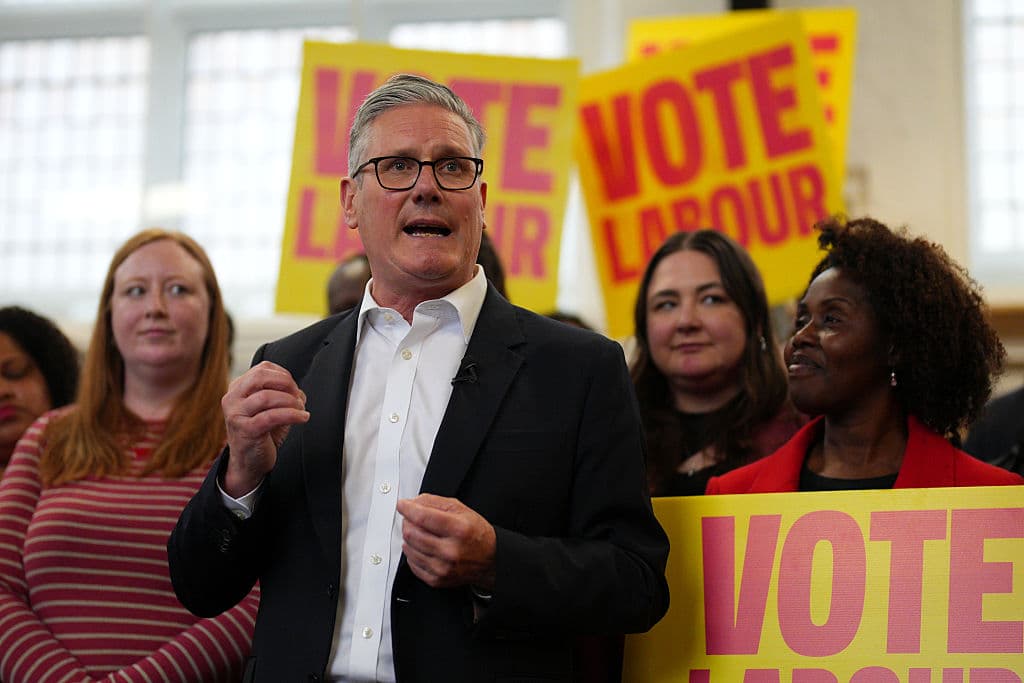
Not long before Britain's recent local elections, Home Secretary Shabana Mahmood told "white liberal" protesters to "f-ck right off" for opposing the Labour government's highly punitive migration policy. Mahmood's outburst, while notable for its vehemence, was not the first time a leading figure of Keir Starmer's Labour Party expressed open contempt for progressive British voters. In 2023, Starmer himself threw down the gauntlet to the remaining supporters of his leftist predecessor Jeremy Corbyn: "If you don't like the changes we have made, I say the door is open and you can leave."
On May 7, Britain's progressive voters gave the Labour Party exactly what its leaders asked for. In England, they abandoned Labour for the Greens (or for abstention) in droves. In Wales, they put the progressive nationalists of Plaid Cymru in power for the first time ever. And in Scotland, they helped the Scottish National Party maintain their position as the largest party in the devolved parliament at Holyrood.
Labour's losses were staggering. The party lost more than a thousand council seats and control of many local councils. The big winner, particularly in England's postindustrial towns, was Nigel Farage's Reform UK. Reform gained ground in most parts of the country, and it is currently well-placed to win the next general election.
Considering Reform's viciously reactionary agenda, this situation is alarming. Starmer's comeuppance was richly deserved, and the continued growth of the unabashedly left-wing Greens is heartening. But Farage's rictus of a grin, hovering over the country like a sinister Coney Island funny face, casts a shadow across Britain's future.
The Labour Party is in a bad way. It's not dead, and it could still recover some lost ground ahead of the next general election. Unless the Greens consolidate England's anti-Reform vote like Plaid has in Wales, Labour will continue to be a key component of progressive bloc politics in Britain.
For the foreseeable future, however, it is trapped in the same self-imposed dilemma facing other European center-left parties. Tack rightward on questions like migration to "win back" socially conservative working-class voters but lose progressives while failing to stem the radical right's advance. Or go radical on economics to (re)unite their base, which entails picking fights with powerful interests they don't want to have.
In the meantime, they'll be squeezed between progressive rivals on their left and reactionary populists on their right. If Labour and its counterparts elsewhere want to avoid permanent relegation, they must find ways of escaping this dilemma — and fast.
Since Labour lost many seats and councils to Reform, it may seem that this means they lost many voters to Farage's party. While some former Labour voters undoubtedly switched to Reform, the data we have suggests this isn't the main driver of Labour's dismal performance.
As the scale of Labour's collapse became clear, the political scientist Rob Ford issued a cautionary word to pundits and strategists: "I fear Labour people risk falling into an ecological fallacy visible from space when reacting to these results. Here is what is very clear in results so far: Labour are losing *seats* to Reform, but . . . Labour are losing *votes* to the Greens."
Sir John Curtice, Britain's foremost polling expert, reinforced his point. "A sharp fall in Labour's performance," Curtice observed, "is accompanied more often by an above average Green performance than it is by a strong Reform performance." Labour losses to the Greens, compounded by Conservative losses to Reform, often means, Curtice concluded, the "net effect can be that Labour end up losing a seat to Reform."
After the results came in, Patrick English of the research outfit YouGov analyzed ward-level data. His findings backed up Ford and Curtice. "Overall," English determined, "we can pretty reasonably conclude from the election results data and the polling evidence that the Greens are a bigger threat to the Labour vote than Reform are."
The Greens' growing strength is reflected in the BBC's projected national share (PNS), which estimates what the parties' results would look like if there had been local elections everywhere in the country. Reform came first in the PNS, but its share was 26 percent, down four points from last year's local elections. Meanwhile, the Greens jumped to second place at 18 percent, up seven points from 2025; Labour slumped to third, one point behind the Greens, while the Conservatives tied with Labour at 17 percent.
These are remarkable results for a country where Labour and the Conservatives — two parties that have dominated British politics for over a century — split roughly 60 percent of the PNS between them as recently as 2024.
The research firm Persuasion UK conducted extensive polling among British voters in the weeks leading up to the elections. What they found, even though it estimates prospective rather than retrospective turnout, reinforces the notion that voter defections to the Left ultimately hurt Labour more than losses to the Right.
According to their data, only 5 percent of 2024 Labour voters in England planned to leave them for Reform this year, while 22 percent looked to the Greens and 10 percent to the Liberal Democrats. Nearly a quarter of English 2024 Labour voters in the sample said they would simply not vote. All told, just 33 percent of English 2024 Labour voters said they were sticking with Starmer in 2026.
By contrast, 78 percent of English 2024 Reform voters in the sample said they would stick with their previous choice (the most of any English party). Just 14 percent planned to abstain. Labour's left flank simply collapsed in Wales, where Plaid Cymru successfully consolidated the anti-Reform vote that fragmented in England.
In the Persuasion UK survey, over 40 percent of Welsh 2024 Labour voters said they would switch to Plaid (as did over 40 percent of 2024 Welsh Green voters, for that matter). Like Reform in England, Plaid seemed to benefit from differential turnout. Seventy-four percent of their 2024 voters said they would stick with them in the survey, while just 10 percent said they would stay home. By contrast, just 19 percent of Welsh 2024 Labour voters in the sample said they would stick with Labour, while a quarter said they would stay home.
"Across the UK," the Persuasion UK researchers concluded, "the Labour 2024 vote primarily stayed at home or voted for another party," and that party typically was not Reform. Labour's left defectors indicated an openness to returning to the fold in future elections, primarily to keep Reform out of power, but they're experiencing "a values-based disconnect" from the Labour Party, according to Persuasion UK's research. "They report no clear sense of what the party stand for and report a general sense of the government, fairly or not, as being 'Tory lite' or more right wing than they expected."
The three most common reasons English 2024 Labour voters gave for switching to the Greens were "their policies and values are closest to my own," "they want to tax the rich and redistribute wealth," and "they would take water, rail and other utilities back into public ownership."
Green leader Zack Polanski's "eco-populism" has clearly won over voters looking for left-wing economic policies that they are not getting from Starmer's Labour Party. The Greens do particularly well, according to Persuasion UK's data on England, among financially insecure voters with liberal social attitudes, while Reform wins over financially insecure voters with conservative social attitudes. Squeezed from both directions, Labour can't seem to figure out who it represents or what it stands for.
The party thought it had a solution in the strategy devised by Morgan McSweeney, Starmer's former chief of staff, who was forced to resign last year over the Peter Mandelson scandal. "It was McSweeney," writes journalist Adam Bienkov, "who devised Starmer's 'Blue Labour' strategy of focusing on what he described as Reform-sympathetic 'hero voters' in the Northern 'red wall,' whilst spurning Labour's younger, more liberal, metropolitan core vote in cities like London."
Labour's 2024 general election victory, when it won a huge parliamentary majority that made Starmer the first Labour prime minister in over a decade, appeared to vindicate McSweeney's strategy. But it was a "sandcastle majority," built more on disenchantment with a series of erratic Tory governments and the disproportional effects of Britain's first-past-the-post electoral system than on popular enthusiasm for Labour's post-Corbyn makeover.
Starmer's government promptly washed it away by embracing a hard-line migration policy that alienated progressive voters and a sweeping program of benefit cuts that would have fallen hardest on Labour constituents. The cuts set off a major rebellion among Labour members of parliament, and the rebels won concessions that shielded the most vulnerable from their impact. But the political damage was done, and Starmer's government never recovered from it.
The Greens' February by-election win in Gorton and Denton, a working-class constituency in metropolitan Manchester, proved to be a harbinger of what May's local elections had in store for Labour. If the Greens could win there, it wouldn't be long before they could start overtaking Labour in London. While Labour's losses in the capital could have been even worse, the Greens' breakthroughs in Hackney, Lambeth, and Lewisham show that Labour's monopoly on left-wing urban districts has been broken.
The historic parties of social democracy, Labour included, keep asking themselves how they can "win back" voters from the radical right. That's not quite the right question to ask, and asking it turns them into the proverbial drunkard looking for his lost keys under the streetlight. "The political paradox of England's post-industrial towns," concludes researcher Sacha Hilhorst, is that "the local people who can be won over to progressive politics will only be convinced by being less like Reform, not more." The first step to recovery, it's said, is admitting you have a problem. It also helps to understand what exactly the problem is in the first place.