Trump opens door for Argentina to escalate push for oil-rich Falklands
After Trump said he was reviewing his position on the Falklands, Argentine President Javier Milei targeted companies involved in offshore oil development around the British-controlled islands.
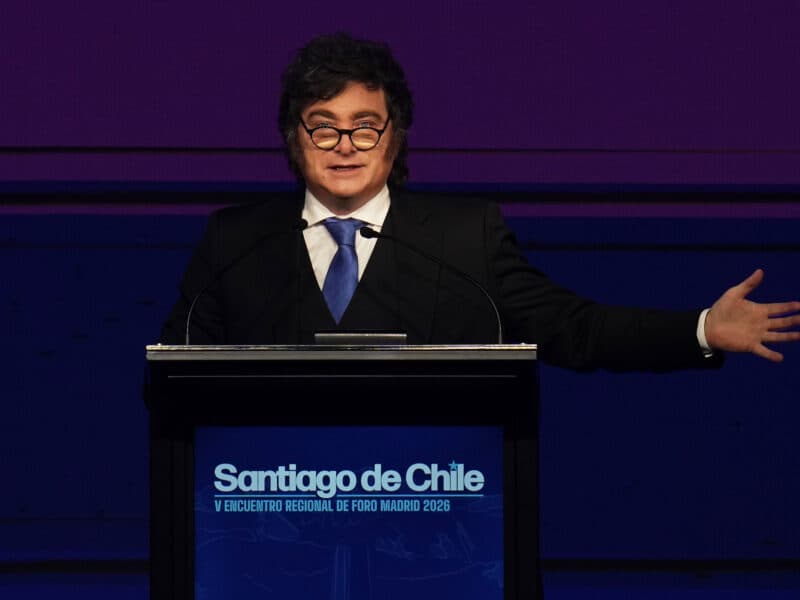
BUENOS AIRES (CN) — Argentine President Javier Milei stepped up his nation's long-running claim to sovereignty over the Falkland Islands on Thursday, announcing tougher sanctions on companies involved in oil exploration around the British-controlled South Atlantic islands and revealing plans for a new naval base.
The measures come days after U.S. President Donald Trump unexpectedly suggested that Washington may be reconsidering its position on the dispute in light of Britain withholding full support for the Iran war.
In a national broadcast, Milei said his government would accelerate sanctions against companies involved in what Argentina considers unauthorized resource exploitation in the Falklands, mainly those involved in the so-called Sea Lion project led by British and Israeli companies. He also announced a bill to strengthen those sanctions and potentially extend their reach to companies' shareholders, directors and suppliers.
The immediate focus is Sea Lion, an offshore drilling project operated by Britain's Rockhopper Exploration and Israel's Navitas Petroleum. The field, located north of the islands, is expected to start pumping oil in 2028. Argentina considers the project an illegal exploitation of resources in territory and waters it claims as its own.
Argentine law already allows the government to penalize companies involved in unauthorized hydrocarbon activity around the Falklands. What Milei is changing is the speed and potentially the scope of enforcement, raising the possibility of consequences for companies that want to participate in Falklands oil while also doing business in Argentina.
That is where the measures could have real economic teeth. Companies involved in Sea Lion could potentially face restrictions on business opportunities in Argentina, including in Vaca Muerta, the country's enormous shale oil and gas formation. Since he arrived in office in 2023, Milei's administration has placed a strong bet on foreign investment in the energy sector to alleviate Argentina's economic malaise, with Vaca Muerta as one of its core pitches to global investors.
"It raises the cost for foreign companies who are keen on investing in Argentina, because they'd be excluded from Vaca Muerta," Argentine political scientist Ignacio Labaqui said. "And it shows that Argentina doesn't passively accept the exploitation of resources in a territory it considers its own."
Milei also announced more resources for defense, plans for a naval base in Tierra del Fuego — the southernmost province of the Falklands — and the creation of a National Security Council. His government says the measures will strengthen Argentina's ability to defend its sovereignty and its interests in the South Atlantic and Antarctica.
The naval base could interest Washington because of Tierra del Fuego's strategic location at the gateway to Antarctica and the South Atlantic, particularly as the U.S. seeks closer maritime and security cooperation with Argentina in a region where it is increasingly focused on Chinese activity.
The timing is also significant because of Trump.
On Monday, when reporters asked whether the U.S. was reviewing its position on the Falklands, Trump responded: "I always review every position — that's just one of many." The comment was notable because the U.S. has traditionally maintained a neutral position on the sovereignty question since the 1982 war while recognizing British control of the islands.
When asked during a recent interview with a British reporter whether the U.S. would back Britain if another conflict over the islands occurred, he said: "Your country was not there to help me."
Trump's comments do not amount to U.S. recognition of Argentine sovereignty, but Milei has clearly interpreted them as an opening. In his address, he spoke of "winds of change" that were beginning to favor Argentina.
The unusually close relationship between Milei and Trump — and the distance between the American leader and the U.K. — offers Milei an opportunity to tap into a popular issue, especially as corruption scandals complicate his reelection bid next year. "He will seek to get the most out of his proximity to the U.S. government," Labaqui said.
The dispute around ownership of the islands, known in Argentina as the Malvinas, also resurfaced in July after Argentina beat England in the World Cup semifinals. Argentine players Lisandro Martínez and Giovani Lo Celso displayed a banner reading "Las Malvinas son Argentinas," violating FIFA rules barring political banners at stadiums and reviving tensions around an issue that remains deeply emotional in both countries.
In the short term, Milei's sanctions impact very little on the ground. Britain maintains control, and Argentina has no realistic military means of changing that. The naval base and increased defense spending are longer-term investments that signal strategic intent rather than an immediate shift in the balance of power.
The question, then, is what Milei's announcements actually change.
"He did raise a more assertive rhetoric," said Mariana Altieri, a foreign policy expert specializing in the Falklands. "He's shifting from a collaboration tone toward a more confrontational one."
Locally, Altieri said, it does represent a change in the stance of the Milei government toward the historical claim.
Argentina likely cannot prevent the development of oil resources from territory it does not control, but it can try to make participation more expensive for the companies involved. That could create uncertainty for investors and discourage additional companies from joining the project.
The measures do not change sovereignty, but they do give Argentina some economic leverage over the companies involved in resource development around the islands. The next test, experts say, could come at the upcoming United Nations General Assembly later this month, where representatives from both countries are likely to address the matter.
Lucía Cholakian Herrera is a Courthouse News correspondent covering Latin America. She is based in Buenos Aires, Argentina.