We Need to Bury the "Clash of Civilizations" Theory for Good
The discredited "clash of civilizations" theory keeps bouncing back because it dresses up sordid resource wars in mock-heroic clothing. After another disastrous war informed by such fantasies, it's time we changed the script.
Over the years, philosophers and theorists have launched a big idea at various moments. In summer 1993, with no little hubris, Samuel Huntington articulated a grandiose global model in an essay for the influential journal Foreign Affairs, titled "The Clash of Civilizations?"
It was a pivotal moment following the end of the Cold War, and others were celebrating the new emerging globalism. But Huntington's formulation caught fire as the bold vision needed within the American establishment, though it was terribly flawed, reductive, and lacking in depth and rigor.
Successive catastrophic wars in the Middle East, culminating in Donald Trump's attack on Iran, have shown us how dangerous and damaging such perspectives on the world can be.
Huntington presented a fearful world deeply divided, not by economics or the competition for world markets, but by a vague, inelegant term of his own coinage: "civilization identities." In this world destined for conflict, he imagined a future where struggles between seven or eight different "civilizations" would pose threats to the West.
Writing about Huntington's work in the Nation, Edward Said observed that the conflict between Islam and the West consumed "the lion's share of his attention." Said also noted that Huntington drew heavily on the work of "veteran Orientalist" Bernard Lewis, whose unsubtle Islamophobia was evident in the title of his 1990 essay, "The Roots of Muslim Rage."
Said the scholar was appalled by the crudity of Huntington's definitions of "civilizations," which he presented as "sealed-off entities" purged of the many "currents and countercurrents that animate human history," and that over centuries had allowed them to contain religious wars and engage in processes of cross-fertilization and sharing. Lost in his absolutist thinking were the nuances of internal dynamics and the pluralities of contending forces contained within every civilization.
Needless to say, Huntington could not imagine a global trajectory driven by peaceful coexistence, universal human rights, and global citizenship. He could certainly not envisage cultural fusions, such as those of music and cuisine that emerge especially where diasporic communities intermingle worldwide.
Huntington certainly got it wrong by misconceiving the world as a set of armed camps in an ever-evolving standoff, with simple binaries of good versus evil, modern versus backward, Christianity versus Islam. But the model became a prophecy, as it provided a useful tool with which to justify modern wars.
After the 9/11 attacks, which should have been treated like the criminal actions they were, the Bush administration chose instead to look at the conflict through a Huntingtonian lens. George W. Bush described his "war on terror" as a "crusade." It was us against them, civilization against barbarism, in a simplistic world of black and white. In other words, the West against Islam.
The Islamic world had become by then a mythical place where the ills and consequences of capitalism could be stored. The outcome demanded by this Orientalist narrative was the promise of its destruction. Only constant attacks across this global divide would be able to bring back the well-being lost in a broken society that was growing steadily more unequal with a declining sense of social justice.
American wars are no longer "won." They have become forever wars that result in the destruction of entire states with the attendant dismantling of the fabric of civilian life, from Iraq to Libya. Huntington's framework is still being used to hide the world as it is and to justify the destruction brought about by wars of aggression and resource extraction in the Middle East.
So rudimentary and simplistic was "The Clash of Civilizations" that Said likened it to a cartoon where Popeye and Bluto were forever fighting. But Popeye, who wears a US Navy uniform, always emerges as the victor, sporting a tattoo of a ship's anchor on his overdeveloped forearms.
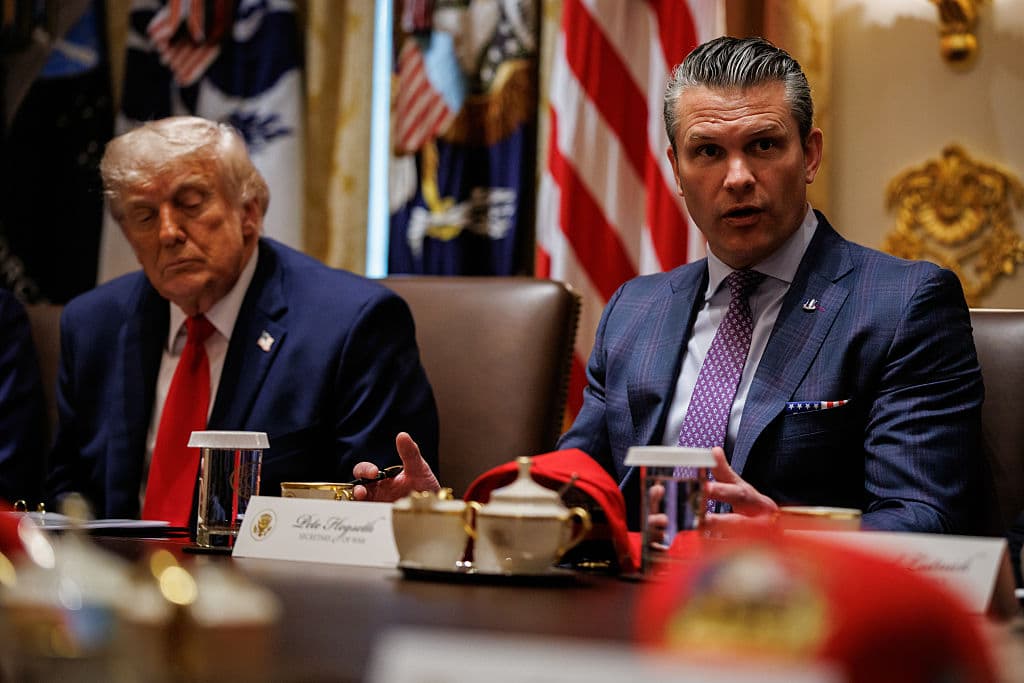
Today the US Secretary of Defense is Pete Hegseth, a self-proclaimed "Christian warrior" with an equally cartoonish worldview who carries a tattoo on his overdeveloped right bicep that reads "Deus Vult," meaning "God wills it." The call to arms dates back to the Crusades and has entered the video-gaming lexicon made popular by Crusader Kings and other war games of total destruction.
Hegseth also has an inked Crusader cross on his chest and the word "Kafir" on his torso that means, in his circles, "infidel," underscoring his Islamophobia. On April 15, at an already controversial prayer service at the Pentagon, Hegseth solemnly recited what he said was the biblical verse "Ezekiel 25:17." In fact, there was no such verse: he had "borrowed" from Quentin Tarantino's Pulp Fiction as if it were scripture.
The episode was equal parts absurd and distressing. Hegseth's demonstrated ignorance of the Bible he purports to follow overlaps with his even greater failures to grasp geopolitical realties. The new Crusade that Hegseth believes himself to be leading took the lives of 156 Iranians in a single strike, most of whom were schoolchildren, on the first day the US military started bombing Iran.
From the start, in our modern interconnected world, this war was destined to fail as its impact was felt through economic hardship across the United States. Yet neither Hegseth nor Donald Trump seemed to know anything about that. Iran's move to close the Strait of Hormuz came as a complete surprise to the warmongering duo, even though it had been a part of Iran's defense strategy for years.
The Trump–Hegseth threats and attacks on Iran carried the baggage they have absorbed through mythic battles that always end in US victory. Frustrated with Iran's refusal to fold under the pressure of American military might, in desperation Trump made a lurid threat on social media: "A whole civilization will die tonight, never to be brought back again."
As Said observed in 2001, it is easier to "make bellicose statements" than to sort out what we are dealing with in reality, the interconnectedness of innumerable lives, "ours" as well as "theirs." Even a former ice cream maker like Ben Cohen could see the connections Said spoke of. While Cohen was getting arrested for demanding a halt to weapons for Israel, with his hands zip-tied behind his back he shouted, "Congress is paying to bomb poor kids in Gaza and paying for it by kicking poor kids off Medicaid in the US."
Said described Huntington's concept as a gimmick, "better for reinforcing defensive self-pride than for critical understanding of the bewildering interdependence of our time." With astounding ignorance and bellicosity, Trump suggested that the only way out of his war on Iran was the genocidal destruction of an entire civilization.
Ironically, the promoters of endless conflict now reluctantly admit that Iran's victory reflects the decline of US hegemony. As one such figure, Robert Kagan, wrote in the Atlantic, "The global adjustment to a post-American world is accelerating. America's once-dominant position in the Gulf is just the first of many casualties."
Modern wars are not fought only with weaponry but also by propaganda and perception management, and years of prolonged media warfare helped shape both external and internal perceptions of Iran. The years of sanctions, economic pressure, and international isolation normalized the view that Iran was technologically backward and structurally weak. But Iranians have learned that their country is materially and institutionally far stronger than years of Western narratives have claimed.
The United States, a country that once enjoyed its unipolar moment and world hegemony, is no longer the moral or military North Star of the Western world. The image of American freedoms and the country's role in exporting respect for human rights has been thoroughly dismantled by US support for Israel's genocide in Gaza. European countries finally expressed outrage after Israeli forces raped and tortured European and Australian citizens kidnapped in international waters, doing what they have done to Palestinians for years.
As for the image and status of the United States internationally, Iranian Lego video parodies of Trump and his war have racked up hundreds of millions of views online. With every blustering false announcement of a "great" new settlement with Iran, immediately exposed as a madman's fantasy, the international image of the US sinks to depths unimagined just a few years ago.
Heather Cox Richardson has drawn our attention to a commencement speech at the University of Michigan by President Lyndon B. Johnson on May 22, 1964. LBJ put a name to a new vision for the United States that he called "the Great Society."
In that society, America would demand an end to poverty and racial injustice and elevate our national life. It would care for the environment and enable every child to learn and grow, and cities would fulfill our desires for beauty and our hunger for community. It would look forward, "beckoning us toward a destiny where the meaning of our lives would match the marvelous products of our labor."
When Johnson promised to assemble the best thought and the broadest knowledge from all over the world to achieve this dream, he acknowledged that the search for an enlightened state would have to be a global project. But LBJ could not fulfill the promises he made because he chose not to run for reelection in the face of opposition to the Vietnam War. Johnson's vision of a Great Society was incompatible with his invasion of Vietnam, and with the ignorance, belligerence, and racism that Huntington championed in his clash-of-civilizations thesis.
War and destruction are incompatible with joy and well-being, and their embeddedness in US thought must come to an end, just as the war in Iran and the genocide in Gaza must. As Richardson points out, we have the power to shape the civilization we want, and only if we try will the US emerge as a global member state in the complex, multipolar world we will now be living in.