'You could hear the flies': ICC probes 'climate of terror' claims at Libyan jail
ICC prosecutors opened the court's first full Libya hearing Tuesday with graphic accounts of torture, rape and fear inside Tripoli's notorious Mitiga Prison.
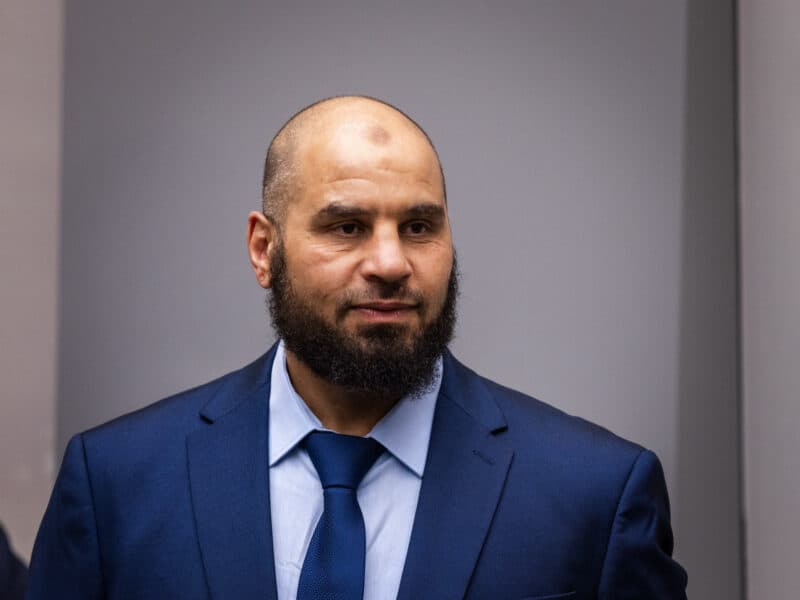
THE HAGUE, Netherlands (CN) — A man prosecutors call the "angel of death" at one of Libya's most notorious prisons sat expressionless in a Hague courtroom Tuesday as the International Criminal Court opened its first full hearing into war crimes in Libya.
Judges will now decide whether Khaled Mohamed Ali El Hishri should stand trial on 17 counts of war crimes and crimes against humanity linked to Mitiga Prison, a detention complex near Tripoli prosecutors say became a hub of torture, rape, killings and arbitrary detention after Libya fractured into rival governments and militias following Moammar Gadhafi's fall.
Libya never joined the International Criminal Court, but the U.N. Security Council gave prosecutors authority to investigate crimes tied to the country's 2011 uprising, when Gadhafi's crackdown on protesters spiraled into civil war and a NATO-backed military campaign helped bring down his regime. The Hague tribunal, created in 2002 to prosecute genocide, war crimes and crimes against humanity, has long drawn political backlash from countries including the United States, which never joined the court and has often accused it of overreach.
Since the Security Council referral, the Libya investigation has lurched through years of dead ends and unfinished cases. Proceedings against Gadhafi ended after he was killed in 2011, his son Saif al-Islam Gadhafi remains wanted by the court, and the case against former intelligence chief Abdullah al-Senussi was ruled inadmissible because Libyan authorities were prosecuting him domestically. El Hishri is the first Libya suspect ever to physically appear before ICC judges.
Prosecutors say El Hishri, also known as Khaled al-Bouti or Sheikh Khaled, rose through the Special Deterrence Force, or RADA, a powerful armed group that expanded across Tripoli during Libya's post-revolution turmoil. They accuse him of controlling the women's section of Mitiga Prison between 2014 and 2020 while personally participating in torture, sexual violence, unlawful detention and killings.
German authorities arrested him in July 2025 under an ICC warrant before transferring him to The Hague months later. Prosecutors urged judges to send the case to trial, with Deputy Prosecutor Nazhat Shameem Khan describing Mitiga Prison as a place where "the complete disregard for the rights and dignity of detainees was institutionalized to create a climate of terror."
Khan described overcrowded cells, detainees beaten with shovels, women assaulted in front of children and prisoners denied food, water and medical care. The charges cover at least 945 detainees, including Libyans, African migrants, women, men and children.
Witnesses described El Hishri as one of the prison's most feared figures, Khan said, with one detainee calling him "the angel of death." Another recalled that when he entered the prison, "you could hear the flies," because everyone inside fell silent in fear.
Prosecutors said the abuse stretched across Libyan society, targeting political opponents, migrants, women, children and people accused of violating the group's religious or social rules. Khan rejected any suggestion the violence came from a few rogue guards, telling judges: "These were not isolated acts of rogue, Mitiga prison guards. These crimes were deliberate, widespread and systematic."
Defense lawyer Yasser Mohamed Ahmed Hassan largely sidestepped the detailed abuse claims Tuesday, saying the defense would respond later in the week. Instead, he launched a sweeping attack on the court's authority to hear the case at all.
Hassan argued the U.N. resolution underpinning the ICC's Libya jurisdiction was aimed at crimes tied to the 2011 uprising against Gadhafi, not later actions by post-revolution security bodies. He also insisted prosecutors distorted Libya's fractured postwar reality by portraying RADA as an outlaw militia rather than part of the Libyan state. "The RADA is a governmental entity and not an armed group," he told judges.
Much of the defense argument turned into a broader attack on the NATO intervention that helped topple Gadhafi. Hassan repeatedly pointed to civilian deaths from NATO airstrikes and accused ICC prosecutors of selectively pursuing Libyan suspects while ignoring claims tied to Western powers. "Is this court only working for the population of the south of the Mediterranean, or was there a shortcoming somewhere in the investigations?" he asked the judges.
The hearing is scheduled to continue through May 21, with prosecutors expected to spend the next two days presenting evidence tied to torture, rape, enslavement, murder and persecution inside Mitiga Prison. A separate defense challenge to the court's jurisdiction will be handled later through written submissions as judges decide whether the case will become the ICC's first full Libya trial.
Courthouse News reporter Eunseo Hong is based in the Netherlands.